You Have Leads, But No Sales: Where Businesses Lose Money After an Inquiry
A business can get more inquiries every month — and still earn less. The reason is often not the advertising, but what happens after the customer reaches out.
The call went unanswered. The callback came a few hours later. No one clarified what the person actually needed. A proposal was promised — and forgotten. The report shows the inquiry. But there’s no revenue.
So before investing more money in advertising, it’s worth finding out how many potential sales the business is losing after the first contact.
Why the Number of Leads Doesn’t Tell You Anything About Revenue
A hundred leads aren’t a hundred customers — they’re a hundred sales opportunities. Each one can be turned into a sale or lost.
The number of inquiries shows how many people called, wrote in chat, or filled out a form. But it doesn’t explain what happened next: whether they got a response, whether the offer suited them, and whether they made it to a purchase.
Consider a hypothetical example of two companies with the same average order value — 20,000 UAH.
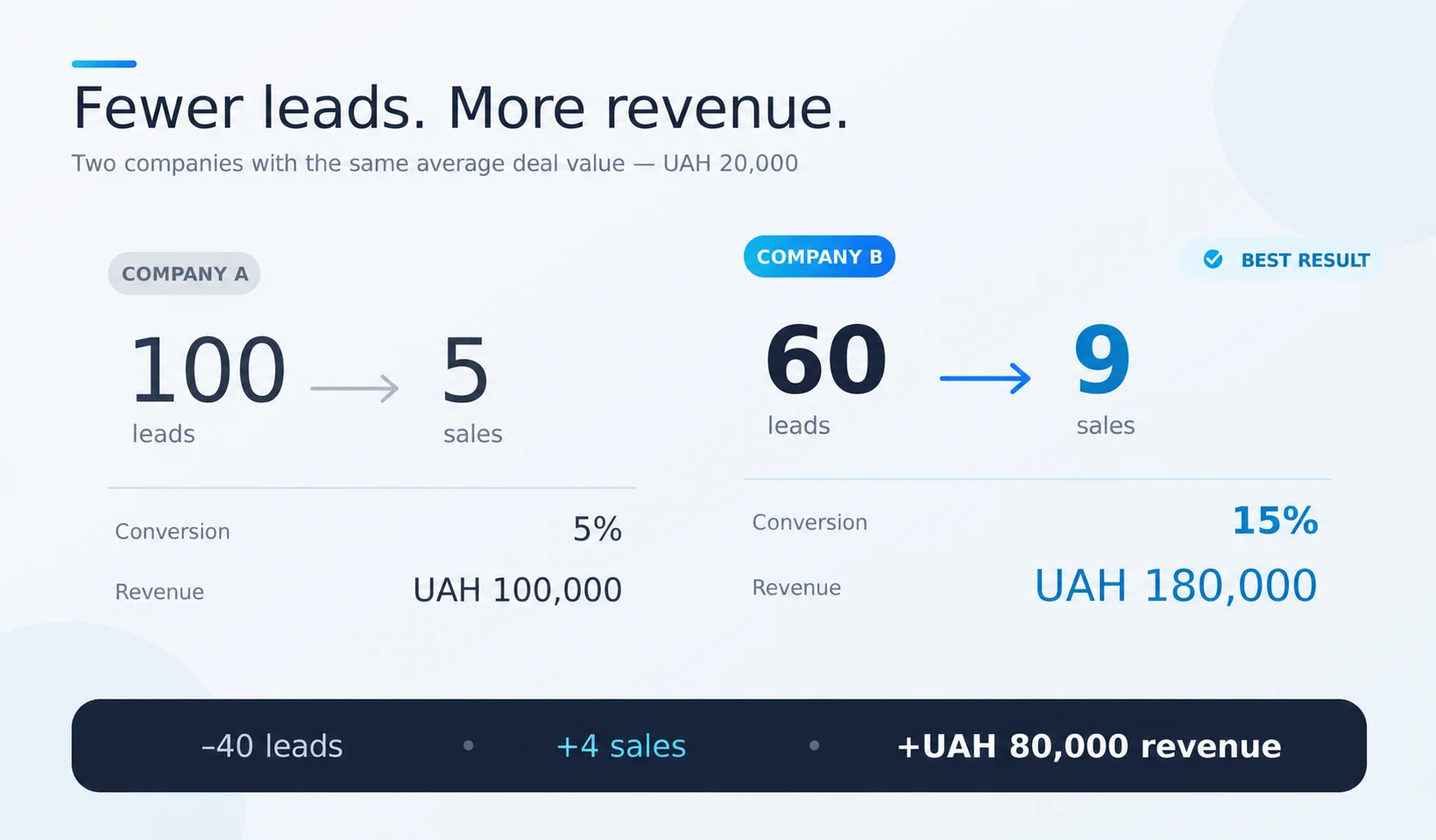
Company B received 40 fewer leads but earned 80,000 UAH more. That result could have come from a faster response, a better understanding of the customer’s need, a relevant offer, and consistent follow-ups.
So evaluating marketing by lead volume or lead cost alone isn’t enough. A cheap inquiry that doesn’t match the business’s offer, or that never gets properly handled, brings no revenue. A more expensive inquiry from someone with a real need can end in a sale and fully pay for the cost of acquisition.
Lead generation isn’t the final result — it’s the start of the revenue process. So before asking marketing for another 100 leads, it’s worth checking what happened to the previous 100.
Where Potential Sales Get Lost After a Customer Inquiry
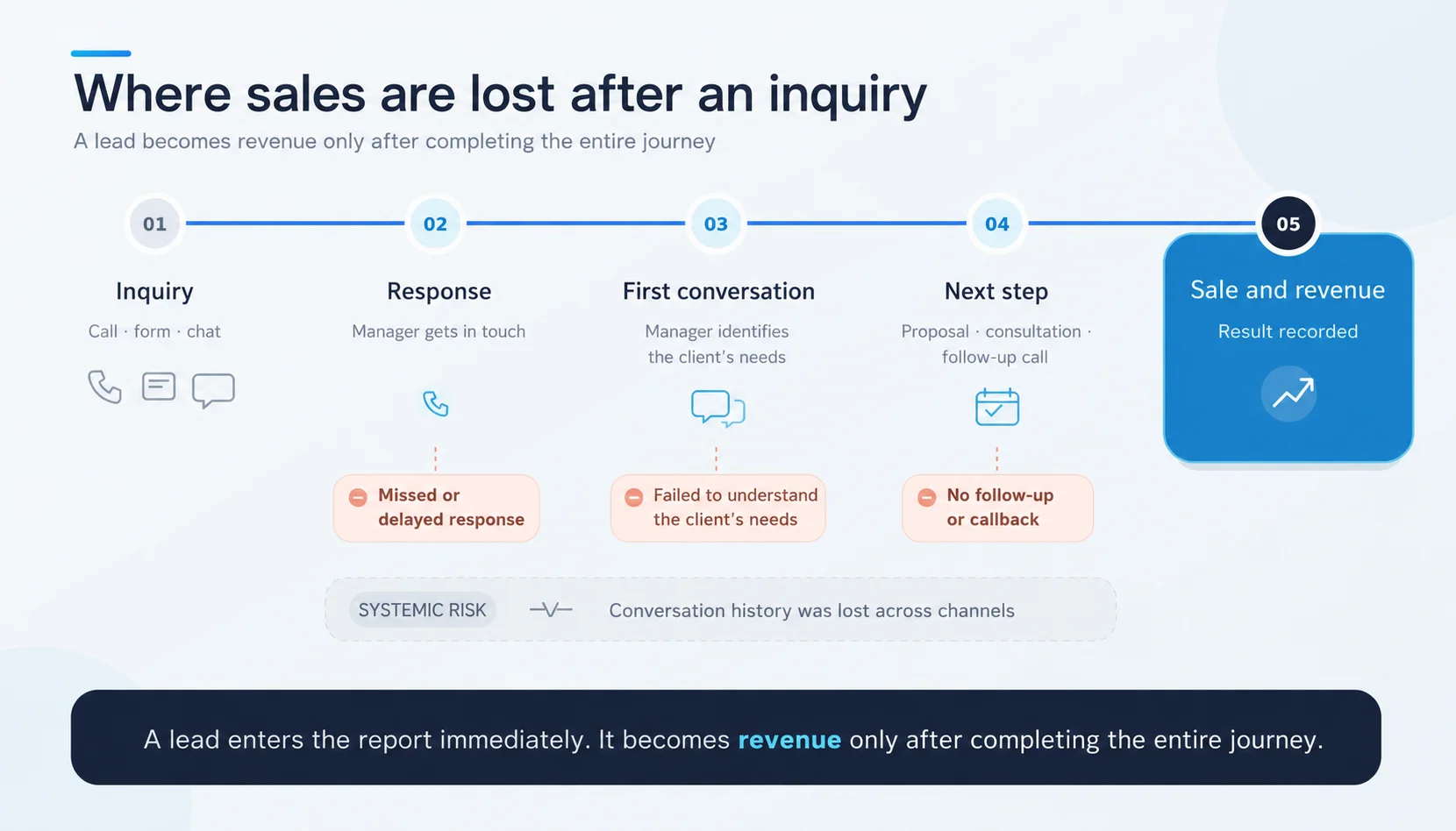
The moment someone calls, writes, or submits a form, advertising has done its job — it caught attention. There’s no sale yet. What happens next depends on how the business handles the inquiry.
The customer didn’t get a timely response
Someone calls, but every manager is busy. They message in chat in the evening, and the message is noticed the next day. They fill out a form that lands in a shared inbox with no notification to the person responsible.
The marketing report records the inquiry, but no one was assigned to follow up. While one company is still sorting out who gets the lead, another is already clarifying the need and agreeing on next steps.
Research from Harvard Business Review found that companies that contacted a potential customer within an hour were almost seven times more likely to successfully qualify the lead than those that responded later. Acceptable response time varies by industry and channel, but the rule is simple: the longer a person waits, the lower the chance the conversation continues.
A unified system for handling inquiries reduces these losses. For example, a virtual PBX distributes calls among available managers and supports queuing and call forwarding. A callback widget lets people request a call from the website, and live chat lets them ask a question without switching channels.
A company needs to define who receives a new inquiry, how quickly they must respond, and who it gets passed to if the responsible manager is busy. For inquiries received outside business hours, the customer should immediately be told when they’ll be contacted.
The manager didn’t identify the customer’s need
Even a fast response doesn’t guarantee a sale. A manager might jump straight into a product pitch without finding out what problem the person is trying to solve, what matters to them, or when they need a result.
In that case, the customer gets a generic offer instead of an answer to their actual request. The company may then conclude the lead was low quality, when in fact the manager simply never uncovered the need.
The first conversation should help understand the customer’s situation, determine whether the product is a fit, and agree on a specific next step: a consultation, a demo, a price estimate, or a follow-up call.
There was no next step after the conversation
Not every sale closes on the first call. A customer might be comparing offers, getting budget approval, or postponing a decision. That’s why every conversation needs to end with a concrete agreement: who will follow up, when, and for what purpose.
“We’ll call you back” doesn’t work if there’s no date and no assigned person behind it.
And a follow-up shouldn’t turn into a string of identical messages. Its purpose is to continue the previous conversation and help the customer move toward their next decision.
Communication history is scattered across different places
A customer calls, sends a follow-up question in chat, receives a proposal by email, and reaches out again a few days later. If these contacts aren’t linked, the manager can’t see the previous conversation, and the customer has to explain everything all over again.
According to McKinsey, today’s B2B buyers use an average of ten interaction channels on their path to purchase. So it’s not enough for a business to be reachable across channels — it needs to maintain a unified communication history.
Integrating telephony with a CRM lets calls, call recordings, and the responsible manager be logged automatically in the customer’s record. That way, the conversation can pick up where it left off instead of starting over.
Managers are overloaded with routine tasks
As the number of inquiries grows, managers don’t just have more conversations to handle — they also have to manually enter contacts, create customer records, log call outcomes, and set reminders.
According to Salesforce, sales professionals spend 60% of their working time on tasks not directly related to selling. On average they use eight different tools, and 42% report feeling overwhelmed by the number of tools they have to juggle.
In this situation, additional leads can increase response times and leave managers even less time for potential buyers. That’s why distributing inquiries, creating records, logging calls, and setting reminders should be automated. For example, automated outbound calling can handle routine mass calls so the team can focus on consultations and negotiations.
Is the Problem Really Lead Quality?
“The leads are bad” is the easiest explanation when there are plenty of inquiries but few sales. Marketing insists it’s bringing in interested people; sales insists they don’t buy anything. As a result, the company changes its advertising without ever identifying the actual cause of low conversion.
Not every inquiry has the same potential. A wrong number or a request for a product the company doesn’t offer genuinely can’t turn into a sale. But a customer who was called back the next day, or who was marked “not responding” after a single failed attempt, can’t automatically be labeled unqualified.
To see the real picture, inquiries should be split into three groups.
Is the Problem Really Lead Quality?
“The leads are bad” is the easiest explanation when there are plenty of inquiries but few sales. Marketing insists it’s bringing in interested people; sales insists they don’t buy anything. As a result, the company changes its advertising without ever identifying the actual cause of low conversion.
Not every inquiry has the same potential. A wrong number or a request for a product the company doesn’t offer genuinely can’t turn into a sale. But a customer who was called back the next day, or who was marked “not responding” after a single failed attempt, can’t automatically be labeled unqualified.
To see the real picture, inquiries should be split into three groups.
| Group of Inquiries | What Belongs to It | What to Check |
|---|---|---|
| Non-target inquiries | Wrong numbers, spam, wrong geography, requests for a product the company doesn’t offer | Ad settings, website forms, and inquiry sources |
| Deferred demand | The customer is interested but is comparing options, approving a budget, or postponing a decision | Whether a follow-up has been agreed on and whether the customer gets relevant reminders |
| Lost during handling | A missed call, a late response, a single contact attempt, or a forgotten agreement | Response speed, inquiry distribution, manager workload, and CRM performance |
A general “not sold” status isn’t enough. Every inquiry needs a specific outcome and a reason for the loss recorded against it. Only then does it become clear what actually needs to change: the advertising, the managers’ work, the call script, or the inquiry-handling system.
Which Metrics Connect Leads to Revenue
A report on inquiries shows how many people entered the funnel. To evaluate the result, you need to see how many of them moved to each next stage — and where the losses began.
| Metric | What It Helps You Understand |
|---|---|
| Share of missed inquiries | How many calls, messages, and forms went unanswered |
| First response time | How long a potential customer waits for a reply |
| Share of established contacts | How many people the team actually managed to talk to after the inquiry |
| Share of target inquiries | How many people the business’s offer genuinely fits |
| Follow-up completion rate | Whether managers return to customers at the agreed time |
| Conversion to sale | What share of inquiries end in a purchase |
| Customer acquisition cost | How much the business spends per actual sale, not per inquiry |
| Revenue by lead and source | How much financial value inquiries from each channel actually generate |
Not every company needs a big dashboard with dozens of metrics. What matters is tracing the sequence: the inquiry arrived, the manager responded, the conversation happened, the customer received an offer, the next step was taken, the sale closed.
If a large share of inquiries doesn’t match the offer, it’s worth reviewing the advertising. If potential buyers wait too long, never receive an offer, or never get a follow-up, the weak point is inside the company. Data should not only show the result — it should explain at which stage it was lost.
How to Build a Process That Turns Inquiries Into Revenue
For every potential customer, there should be a defined next action: call, send information, clarify the decision, or return to the conversation after a set time. Lead handling shouldn’t depend on whether a manager happened to notice the inquiry, wrote down the agreement, and remembered the promised callback. The CRM system should remind managers about tasks — and show managers’ leadership any overdue contacts.
Bring all inquiries into one system
Calls, website forms, chat messages, and other inquiries should all land in a single system. For each inquiry, it’s enough to record contact details, time and channel, acquisition source, the essence of the request, the responsible manager, the current stage, and the next action. Integrating telephony with a CRM makes it possible to automatically log calls, call recordings, and the responsible manager in the customer’s record.
This keeps an inquiry from being overlooked and lets another employee, if needed, continue the conversation without losing context.
Set a standard for the first response
The company needs to define a specific response time for each channel. It also needs a backup plan: if the responsible manager is busy or doesn’t respond within the set time, the inquiry moves to another employee. For inquiries received outside business hours, the customer should immediately be told when they’ll be contacted.
That way, response speed becomes a standard of how the company operates — not something that depends on one person’s diligence.
Align the logic of the first conversation
Managers don’t need to read from an identical script. But every first conversation should have a shared goal: understand the customer’s request, determine whether the product fits, answer the key questions, and agree on a next step.
After the call, both the customer and the manager should understand what happens next.
Record the next action and the outcome
Statuses like “thinking it over” or “call back later” don’t help manage sales without a specific date and a named person responsible. Every active inquiry needs a next action, and every closed one needs an outcome: sale, deferred decision, refusal, or mismatch with the offer.
Reasons for losing a deal should be standardized. This reveals what’s actually costing the business sales most often: the wrong audience, slow response, price, terms, a competitor’s offer, or a missed follow-up.
Feed sales results back into marketing
Marketing needs to know not just how many leads a campaign brought in, but how many of them turned into sales and how much revenue they generated. Call tracking combined with a CRM helps link the advertising source to the call, the communication history, and the deal outcome.
If one channel brings in a lot of contacts but almost no sales or revenue, the budget can be adjusted. If another channel brings fewer leads but they convert to customers more often, it shouldn’t be judged solely by its higher cost per lead.
This kind of feedback loop unites marketing and sales around a shared outcome — revenue.
Automate the organization, not the substance of the conversation
Automation should take repetitive operations off people’s plates — but it shouldn’t replace the manager where understanding the customer, experience, and flexibility are required.
| What the System Can Handle | What Stays With the Manager |
|---|---|
| Log calls, messages, and inquiries | Identify the customer’s need |
| Create a record and store inquiry history | Use context during the conversation |
| Distribute inquiries among staff | Choose the right approach |
| Remind about a scheduled contact | Run the consultation and agree on next steps |
| Send agreed-upon messages | Personalize the offer |
| Record calls and gather statistics | Work through questions, doubts, and objections |
| Flag overdue tasks | Decide how to move forward with the customer |
AI can also transcribe and summarize conversations, group reasons for refusal, or flag problem calls. But the decision about the customer should stay with the team.
Good automation is almost invisible: the customer gets a faster response and doesn’t have to repeat information they’ve already given, the manager spends less time on manual tasks, and leadership sees the inquiry’s full path.
Quick Audit: Is the Business Ready to Bring in More Leads?
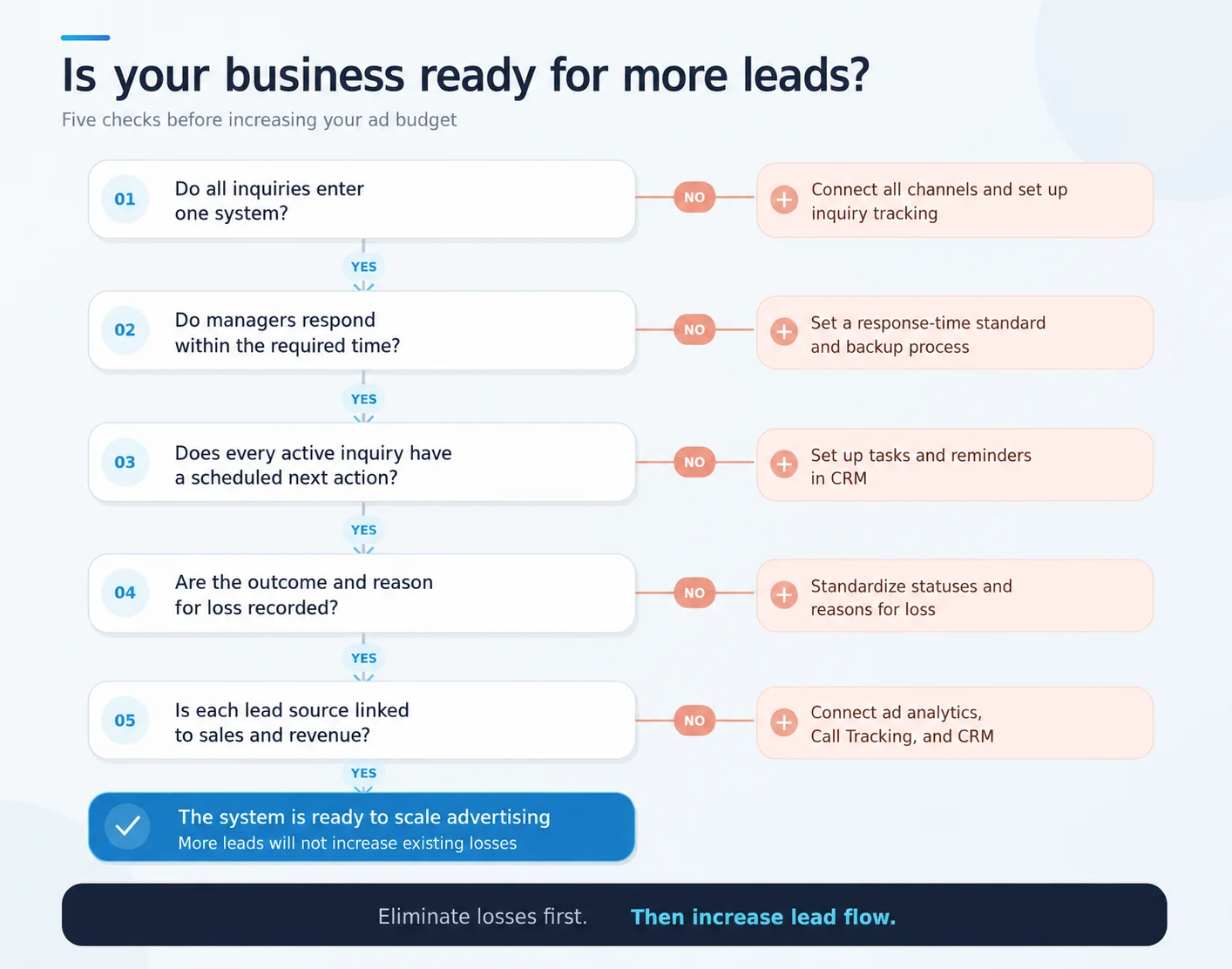
“We don’t know” is also an answer that points to a problem. If a company can’t see how many inquiries went unanswered or why customers didn’t buy, it can’t predict the outcome of scaling up its advertising.
New leads are worth pursuing when current inquiries are handled on time, the team isn’t overloaded, follow-ups are being completed, and conversion stays stable. But if inquiries are piling up, agreements are falling through the cracks, and the reasons for lost deals are unknown, extra budget will just funnel more potential customers into a weak process.
Sometimes the biggest opportunity for growth is already sitting in the funnel — among people who showed interest but never got enough attention to become buyers.
до покупки.
Recommended articles
A client called, but the ad doesn’t “see” it: how call tracking brings phone leads into analytics.
Read article
7 Takeaways From an Analysis of 70 Million Phone Calls: What Businesses Lose on the Phone
Read article