
Back to Business: How to Get Your Communication Infrastructure Ready for the Sales Season
After summer, business returns to its active rhythm: marketing budgets grow, new campaigns launch, teams receive their autumn plans, and everyone prepares for the busiest period of the year.
Usually, the main focus at this point is on getting more inquiries and processing them faster. But before increasing the load on the sales department, it’s worth checking something else: whether the communication infrastructure itself is ready for it.
A customer called, but the call didn’t reach the CRM. A manager spoke with a potential customer from their personal number and didn’t record the agreement. An employee works outside the office, and the manager can’t see their call history. The internet went down — and the team temporarily fell out of the workflow.
While the volume of inquiries is small, such gaps can remain unnoticed. But as the flow grows, every “blind spot” scales along with the business.
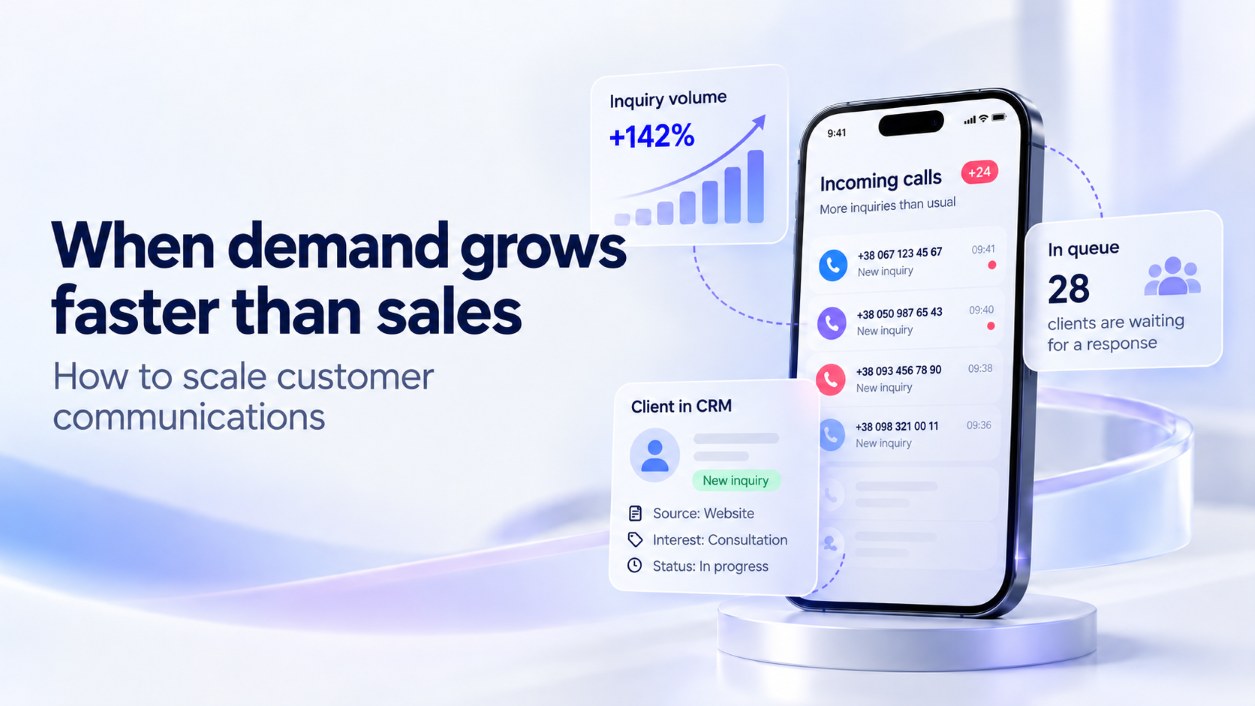
And it’s not just about lost data. The speed of response to an inquiry directly affects the likelihood of turning a lead into a customer. This is confirmed by an InsideSales study based on more than 55 million actions across 5.7 million inbound leads. Conversion was more than 8 times higher when the first attempt to contact a potential customer happened within five minutes, rather than in the window between five minutes and 24 hours.
In other words, even a strong sales team loses its edge if a call isn’t recorded, a contact doesn’t reach the CRM, or a manager doesn’t get the information in time.
That’s why Back to Business should start not only with new sales plans, but also with a review of the infrastructure through which every customer inquiry passes.
Below is a technical readiness checklist from Stream Telecom to help you find weak points and prepare your communication system for the busy season.
Quick Checklist: Is Your System Ready for the Busy Season?
Before increasing the number of campaigns and attracting more leads, check five key points:
- telephony is integrated with the CRM, and call data doesn’t need to be transferred manually;
- inquiry history, missed calls, and call recordings are stored in the system;
- calls made by employees outside the office also remain under the company’s control;
- the team can keep working if the office internet goes down;
- if the primary manager or office connection is unavailable, calls are automatically forwarded to another employee or to a backup mobile number.
If even one of these points isn’t met, as the number of inquiries grows, this gap can lead to lost contacts, unfulfilled agreements, or delayed responses. Below, we break down each part of the infrastructure separately and look at what needs to be checked before the busy season begins.
CRM–Telephony Integration: How to Avoid Losing Customer Data
If telephony operates separately from the CRM, a manager has to manually transfer the number, record the outcome, and create the next task after each call. Under heavy load, this is exactly the stage where data most often gets lost.
Stream Telecom’s CRM–telephony integration allows you to:
- open a customer’s card during an incoming call;
- create a contact or lead for a new number;
- log incoming, outgoing, and missed calls;
- store call recordings in customer cards;
- make calls directly from the CRM.
Stream Telecom supports integrations with KeyCRM, SalesDrive, Zoho, NetHunt, and other systems. The feature set depends on the specific CRM, so before the season it’s worth testing three scenarios: a call from a new number, an inquiry from an existing customer, and a missed call. In each case, the information should appear in the CRM automatically.
Mobile Telephony: How to Track Calls Made Outside the Office
If a manager calls a customer from a personal number, the conversation doesn’t reach the shared system, and the manager can’t see its outcome. This is especially relevant for employees who work remotely or travel frequently.
Stream Telecom offers two solutions for different working conditions:
- Stream Phone — an app for iOS and Android through which an employee makes and receives work calls. Like other IP telephony solutions, it transmits calls over the internet, so it requires a Wi-Fi or mobile data connection to work;
- FMC — a SIM or eSIM card that connects a mobile phone to the corporate PBX. Calls go through the operator’s mobile network, so FMC works without internet access — as long as there’s mobile coverage.
Stream Phone is suited for working over a stable internet connection, while FMC is for employees who need to stay reachable even without Wi-Fi or mobile data. With the integration configured, calls can be saved in the shared history and passed on to the CRM.
Scaling Telephony: Is Your System Ready to Grow?
More customers means more than just more calls. A business may need new managers, internal lines, departments, and more complex call-distribution rules.
Stream Telecom’s virtual PBX allows you to expand telephony without installing physical equipment in the office. Before increasing your load, check:
- whether you have enough simultaneous lines for incoming calls;
- whether a new employee can be added quickly;
- whether calls are correctly distributed among managers and departments;
- whether the manager can see the load, missed calls, and communication history;
- whether the system works the same way for office, remote, and mobile teams.
Telephony is ready to scale if new employees and scenarios can be added without rebuilding the entire system.
Backup Communication: How to Keep Working During Outages
A virtual PBX runs in the cloud and doesn’t depend on equipment in the office. However, managers still need power and internet access to receive calls on their work devices.
Stream Phone runs on IP telephony, so without internet access it won’t be possible to make or receive calls through the app. In that case, FMC can serve as a backup solution: calls go through the operator’s mobile network and don’t require an internet connection.
Before the season, check:
- whether you have backup power for the router and computers;
- whether the team can switch to mobile data and Stream Phone;
- whether calls are forwarded to another manager, to an FMC card, or to a backup number if the primary employee is unavailable;
- whether employees know what to do during an outage.
Call routing and forwarding can be configured in Stream Telecom’s virtual PBX. The scenario should be set up in advance so the team isn’t configuring connectivity from scratch during a disruption.
Communication Infrastructure as the Foundation for Scaling
As the flow of inquiries grows, weak points scale too: one lost call turns into dozens, and manual data transfer starts to slow the team down.
A ready infrastructure ensures calls are logged in the CRM, keeps communications outside the office under control, and allows inquiries to be handled during outages. This lets a business grow its campaigns and customer base without losing data.
Ahead of the busy season, the Stream Telecom team can help review your current system, integrate telephony with your CRM, and set up backup communication scenarios.