Call Tracking During Peak Periods: How to Control Advertising Calls and Stop Losing Customers
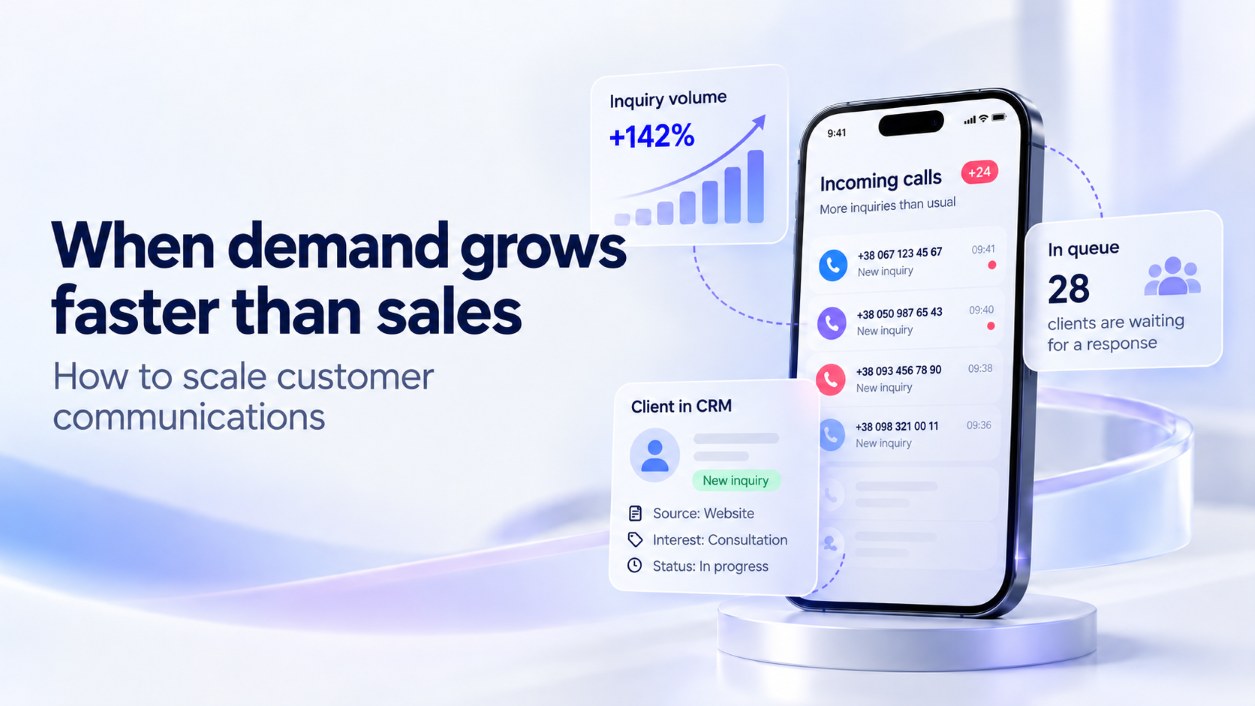
A marketer’s nightmare scenario: the ads are live, the budget is allocated, website traffic is growing — everything seems to be working, so you can relax and watch the numbers climb. Then, a week later, the marketer opens the report and sees something strange: not many leads from the website, while managers complain they can’t keep up with phone calls. The logical question follows: where did those calls go in the analytics? The unpleasant answer — nowhere. They were simply never there in the first place.
This is a typical story for businesses during peak periods: a sale, a season, a major ad campaign. The more money goes into promotion, the more people call directly instead of filling out a form on the website. And if those calls aren’t tied to their advertising source, you only see half the picture of the customer journey — the half that’s convenient to measure, not the half that actually drives sales.
What Call Tracking Is and Why It’s Not Just “Another Analytics Tool”
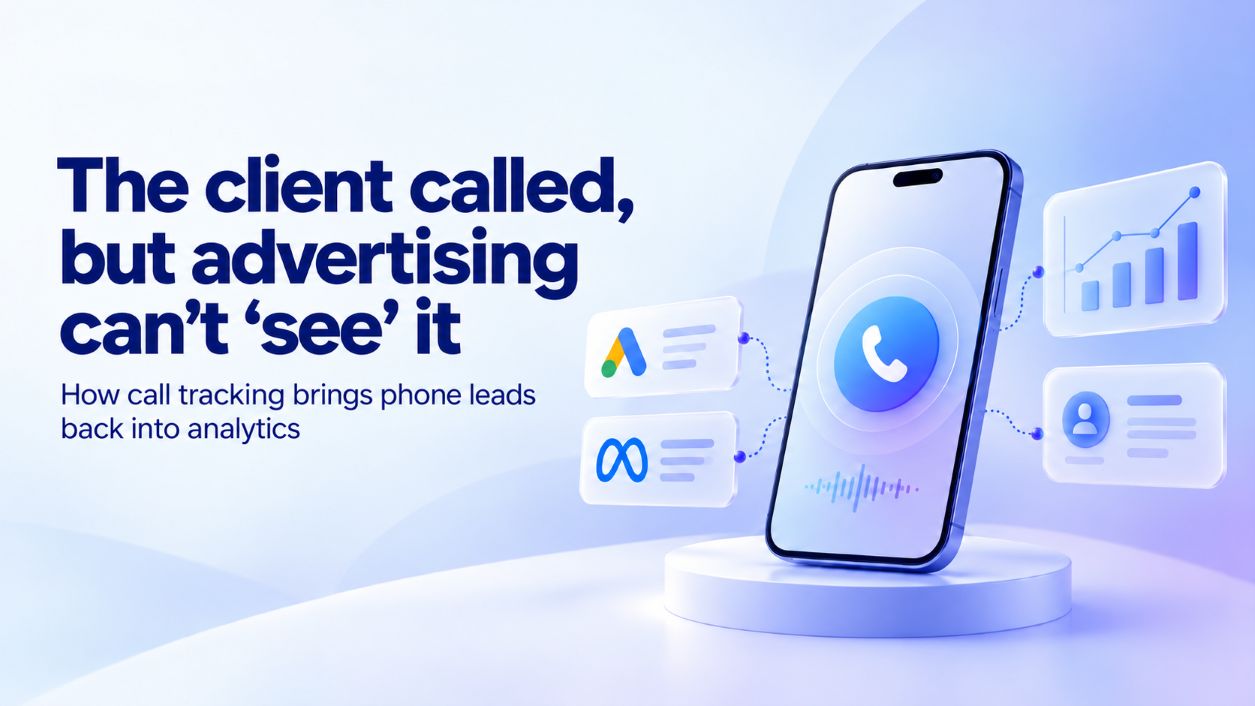
Simply put, Call Tracking is a technology that shows which advertising channel a call actually came from. There’s no magic involved: a separate phone number is assigned to each traffic source (Google Ads, Instagram, a billboard, radio). When someone calls that number, the system immediately knows exactly where they heard about the company.
There are two main approaches:
Static call tracking — a permanent number is assigned to each channel. Simple and straightforward, ideal for offline advertising: billboards, radio, TV, flyers — anywhere there’s no dynamic website traffic.
Dynamic call tracking — each website visitor is temporarily shown a number from a pool of available numbers. This gives much more precise detail: you can see not just the channel, but the specific campaign and even the keyword that brought the customer in.
And, of course, there’s a combined approach — static numbers for offline channels, dynamic substitution for the website. For a business advertising both online and offline at the same time, this is the most logical path: one system instead of two disconnected pictures.
Schematically, the whole chain looks like this: ad → click-through to the website (or contact with an offline source) → call to the tracking number → source is recorded → manager picks up → deal closed.
Why Regular Web Analytics Simply Isn’t Enough
Google Analytics and ad platforms are great at seeing what happens on the website: page views, clicks, filled-out forms. But the moment a person picks up the phone and calls instead of clicking “Submit request,” the analytics go silent. To the system, that’s just “a visitor left the site,” even though they actually just became a customer.
As a result, advertising channels get evaluated incompletely. A campaign that drives few online leads but a lot of calls looks weak in the reports — and its budget can get cut precisely when it’s performing best. Meanwhile, a campaign with impressive click-through numbers but zero real customers keeps getting more money instead.
What Marketing Questions Call Tracking Answers
Once calls are tied to their sources, you get answers to questions that previously had to be guessed at:
- Which channel actually drives calls, not just traffic?
- Which campaign generates genuine inquiries, and which one brings random, off-topic calls?
- Which keywords bring in customers who are ready to buy?
- How much does one qualified call from a specific source cost?
- Which campaigns are worth scaling, and which need to be reviewed or stopped?
A Lot of Calls Doesn’t Mean a Win
Here’s an important point that often gets overlooked: call volume doesn’t equal lead quality. A campaign might generate 200 calls a day, of which 180 are wrong numbers, job inquiries, or repeat calls from the same people who simply didn’t get an answer the first time.
So besides volume, it’s worth tracking:
- the share of genuine inquiries among all calls;
- repeat calls (a sign that a customer couldn’t get through the first time);
- call duration — a short “hung up” call is very different from a substantive consultation;
- what happened to the call afterward — did it turn into a deal?
Two campaigns can generate the same number of calls and produce dramatically different sales results. You can only see this once calls are linked not just to their source, but to what happened to the customer afterward.
Call Tracking + CRM: From Ad Click to Money in the Bank
Recording a call’s source is only half the job. The second layer of value appears when call data flows into the CRM and gets attached to a specific customer and deal. That’s when the chain closes: channel → call → lead → deal → revenue.
This makes it possible to evaluate advertising not by the number of inquiries, but by its real contribution to revenue. For example, Channel A might generate fewer calls than Channel B, but close twice as many deals for a larger total value — meaning it should get the bulk of the budget, even though “surface-level” statistics would make it look less effective.
It’s also worth mentioning telephony-CRM integration here: Stream Telecom connects its telephony directly to a business’s CRM system, so call data — source, duration, status — is automatically logged into the customer’s card without manual entry. This removes routine work from managers and prevents situations where a call gets “lost” between systems on the busiest days.
Where Businesses Most Often Lose Customers During Peak Periods
The biggest ad campaign in the world won’t save sales if nobody picks up the calls it generates. During peak periods — sales, seasonal rushes, new product launches — the typical points of loss are:
- missed calls when all lines are busy;
- long hold times that make customers simply hang up;
- overloaded managers who can only handle part of the inquiries;
- uneven distribution of calls among staff — some overwhelmed, others idle;
- repeat calls from the same people who didn’t get an answer right away and try again, eating up the team’s capacity a second time.
Good advertising doesn’t fail to deliver results in this situation because it’s bad — it’s because the business physically can’t keep up with what it brings in.
What to Monitor During Peak Days
During peak periods, it’s worth tracking the following metrics daily — sometimes even in real time:
MetricWhat It ShowsNumber of callsOverall volume of inquiriesNumber of qualified callsHow many are actually about a purchaseMissed callsHow many inquiries were lostAverage call durationQuality of inquiry handlingCall-to-sale conversionThe channel’s real effectivenessCost per qualified callHow much a “hot” inquiry costsCustomer acquisition costThe channel’s full economicsRevenue from the advertising channelThe final benchmark for budget decisionsMetricWhat It ShowsNumber of callsOverall volume of inquiriesNumber of qualified callsHow many are actually about a purchaseMissed callsHow many inquiries were lostAverage call durationQuality of inquiry handlingCall-to-sale conversionThe channel’s real effectivenessCost per qualified callHow much a “hot” inquiry costsCustomer acquisition costThe channel’s full economicsRevenue from the advertising channelThe final benchmark for budget decisions
| Metric | What It Shows |
|---|---|
| Number of calls | Overall volume of inquiries |
| Number of qualified calls | How many are actually about a purchase |
| Missed calls | How many inquiries were lost |
| Average call duration | Quality of inquiry handling |
| Call-to-sale conversion | The channel’s real effectiveness |
| Cost per qualified call | How much a “hot” inquiry costs |
| Customer acquisition cost | The channel’s full economics |
| Revenue from the advertising channel | The final benchmark for budget decisions |
How to Prepare Call Tracking for a Peak Period in Advance
Before launching an active advertising campaign, it’s worth running through a short checklist:
- Verify that all tracking numbers are working correctly and not “hanging.”
- Make sure all the necessary advertising sources are tracked, not just the main ones.
- Check the CRM integration — are calls really being linked to customer cards?
- Define clear criteria for a qualified call so the whole team counts results the same way.
- Check how missed calls are being recorded.
- Assess the load on managers and reinforce staffing for peak days if needed.
- Test the entire system with control calls before launching active campaigns — not during them.
Call Tracking is important, but it’s only one part of the communication infrastructure that needs to withstand the load of a peak season. Beyond correctly configured number substitution, it’s worth taking care of overall telephony stability, backup communication channels, load distribution among managers, and integrating all systems with the CRM — it’s the combination of these factors that determines how quickly your team can handle a surge in inquiries. We covered how to prepare a business’s communication infrastructure for the sales season in a separate article: Back to business: how to prepare your communication infrastructure for the sales season.
Call Tracking Isn’t Just for Marketing
Call tracking is often seen as a tool purely for marketers. In reality, its data is useful to the whole team:
- for marketing — to see a customer’s real source instead of guessing where the money is going;
- for the sales department — to understand inquiry quality and catch call-handling overload in time;
- for management — to see a direct link between ad spend and business results, instead of disconnected pieces of statistics.
Call Tracking becomes part of a single communications analytics system, rather than a separate line item in a marketer’s report.
Call Tracking for Your Business — a Solution from Stream Telecom
Setting up call tracking isn’t enough on its own — it needs to be configured to match how your advertising, website, and sales process actually work. That’s exactly what Stream Telecom builds its service around.
The company offers all three call tracking formats — static, dynamic, and combined — and helps you choose the one that fits your specific channels and traffic volume. For offline placements (billboards, radio, print), permanent numbers are assigned; for the website and online advertising, dynamic substitution is used from a pool of numbers sized after measuring actual traffic.
Setup takes a few steps: discussing the task and channels → measuring traffic → configuring tracking and integrations → control calls and checking how sources appear in reports. Stream Telecom says the entire setup cycle takes 1–2 days, and the analytics dashboard opens right after activation.
What matters for a business preparing for peak periods:
- Data on every call — source, campaign, number and duration of calls, missed inquiries, and, with the appropriate tagging, keywords too.
- Integration with CRM and advertising analytics, including Google Analytics — a call can be traced through to deal status and sale amount instead of being left “hanging” as a standalone number. Stream Telecom’s telephony integrates with the CRM directly, so the customer’s card is populated with call data automatically, without manual work from managers.
- Flexibility for your type of advertising — you can connect just a few numbers for basic channels, or roll out a full dynamic system with dozens of numbers for a high-traffic website.
- Clear, transparent pricing: number rental (starting from ₴99/month for city and 0800 numbers), a Call Tracking license (₴125/month per number), and a surcharge for mobile carrier numbers. The final cost depends on the number of phone lines, the depth of analytics, and the integrations required — a separate estimate is prepared for each specific project.
- Technical support and SLA — for the moments when any technical delay during peak days costs you lost customers.
For those who haven’t decided yet, Stream Telecom offers a free trial version of call tracking — you can check how number substitution works and what the reports look like before connecting the full feature set.
Do your customers call after interacting with your ads? Make sure those inquiries don’t stay outside your analytics — especially now, with peak season ahead and every advertising dollar needing to count. Stream Telecom will help you set up Call Tracking for your business and see the full customer journey — from advertising channel to sale.