When Demand Grows Faster Than Sales: How to Scale Customer Communications
How to prepare your sales department for an increase in inquiries, configure your telephony and CRM systems, and reduce the risk of losing potential customers as your business scales.
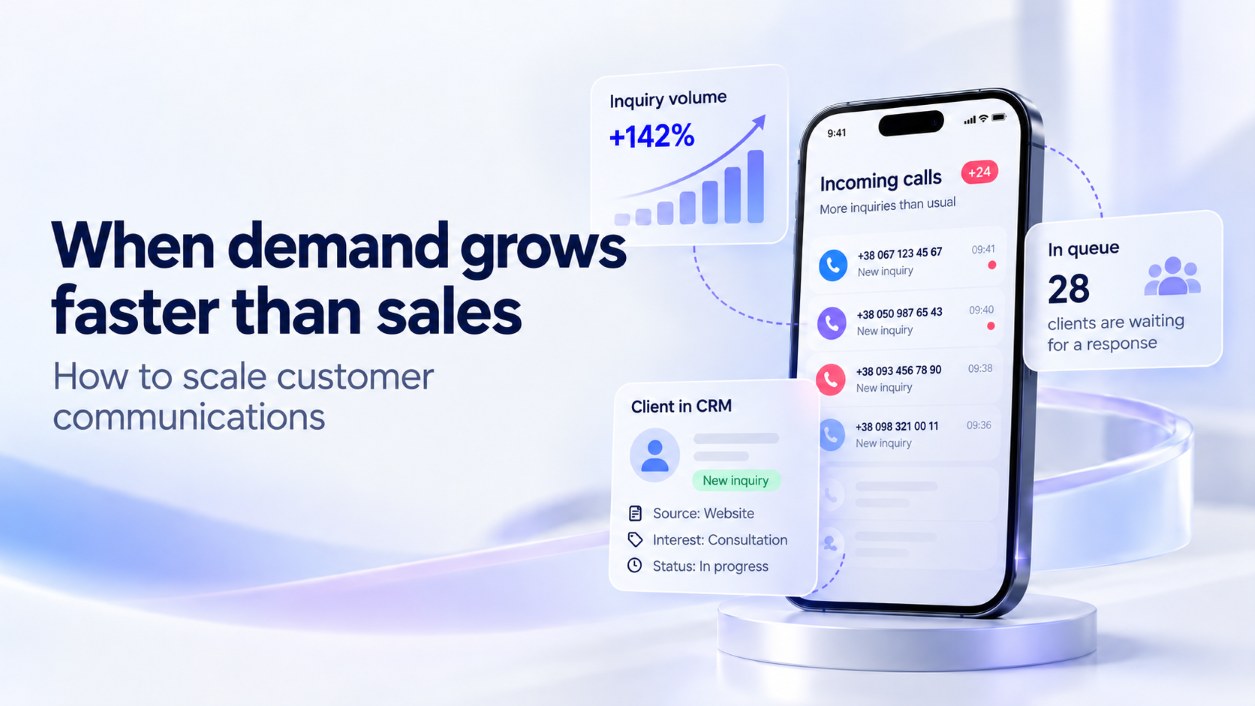
A company increases its advertising budget, expands its sales geography, and generates more inquiries. However, growth in the number of potential customers does not always translate into a proportional increase in revenue. During peak hours, sales representatives struggle to answer calls, customers wait on hold, and follow-up contacts are postponed.
In such situations, the constraint on growth is not the level of demand but the company’s ability to handle it. Let’s examine how to assess customer communication capacity, identify critical bottlenecks, and prepare telephony, CRM, and the team for scaling.
Why More Inquiries Do Not Always Lead to More Sales
Consider a company that launches a large-scale advertising campaign and receives 40% more inbound calls. Its marketing metrics improve: the number of inquiries rises, and the average cost of acquiring a potential customer falls. However, the sales department continues operating with the same headcount, while the number of inquiries handled grows much more slowly.
The reason may lie in the team’s limited capacity. Each sales representative can handle only a certain number of calls during working hours, taking into account call duration, preparation of commercial proposals, entering information into the CRM system, and other tasks.
When the rate of new inquiries exceeds available resources, operational overload occurs. This does not necessarily show up immediately as a large number of missed calls. Initially, customers may wait longer for an answer, consultations may become shorter, or a backlog of follow-up tasks may accumulate.
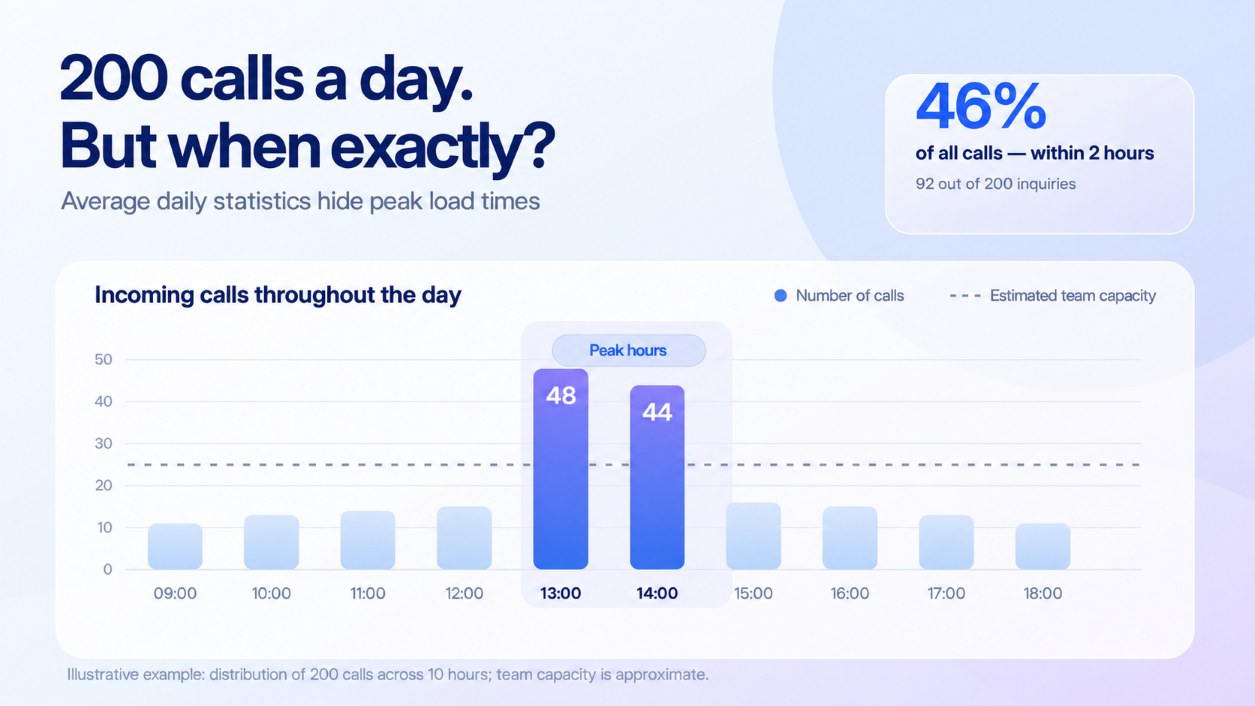
It is especially important to account for uneven workloads. For example, a company may receive 200 calls in a day, but almost half of them arrive within a two-hour period. Daily average statistics may still look acceptable, even though customers have to wait a long time for an answer during peak periods.
In such situations, it is important not only to increase the number of sales representatives but also to understand where delays occur and why some inquiries do not receive adequate follow-up.
Where Businesses Lose Inquiries: Three Critical Stages
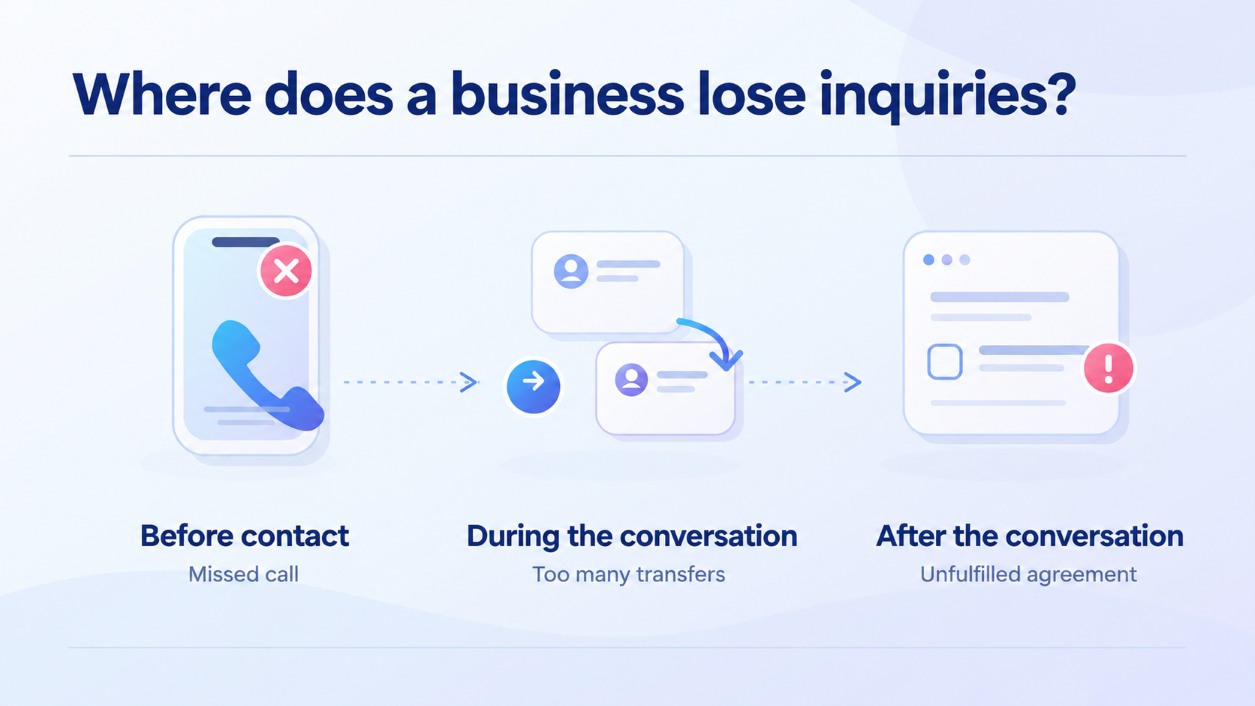
Potential customers can be lost before contact is established, during the conversation itself, or after it ends. Each of these stages has its own challenges, so addressing them requires different organizational and technological solutions.
Before Contact Is Established
The first group of problems relates to how accessible the company is to customers. These include missed calls, long hold times, incorrect call routing, or an insufficient number of available employees.
Imagine that sales representatives in one department are overloaded while another team has spare capacity. Without appropriate routing rules, customers will continue to wait even though the company as a whole has the resources to handle additional inquiries.
However, not every missed call automatically means a lost sale. A customer may have called again or received a callback from a sales representative. It is therefore important to distinguish a missed call from an inquiry for which contact was never successfully established.
During the Conversation with the Customer
Even a successfully answered call does not always result in effective communication. A customer may be transferred between departments several times, asked to repeat information already provided, or kept waiting while a sales representative searches for details of previous interactions.
Such situations increase average call handling time and reduce the team’s capacity. If call volume remains unchanged but more time is spent on each interaction, the workload on sales representatives will increase.
At the same time, reducing call duration should not become an end in itself. Excessively short consultations can negatively affect how thoroughly customer needs are addressed, especially in complex B2B sales.
After the Conversation Ends
The third group of losses occurs after successful contact. A sales representative may promise to call back, prepare a cost estimate, or send a commercial proposal but fail to complete the action within the agreed timeframe.
These cases are harder to detect using telephony statistics. The system shows that a conversation took place, but this does not mean the inquiry received further attention.
To monitor this stage, telephone events need to be linked to tasks and statuses in the CRM. This makes it possible to assess not only the company’s availability during the first contact but also the consistency of subsequent work with the potential buyer.
How to Organize Telephony to Handle Peak Workloads
One way to improve control over communications is to use cloud telephony with flexible call distribution rules.
It is important to understand that multi-line capability alone does not increase the capacity of sales representatives. It allows several simultaneous calls to reach the same number, but available employees are still needed to handle those calls promptly.
An effective telephony architecture must therefore account not only for the technical ability to receive calls but also for the rules governing their subsequent distribution.
Routing Based on the Business Structure
For companies with several sales divisions or regional branches, it is important to separate inbound inquiry flows.
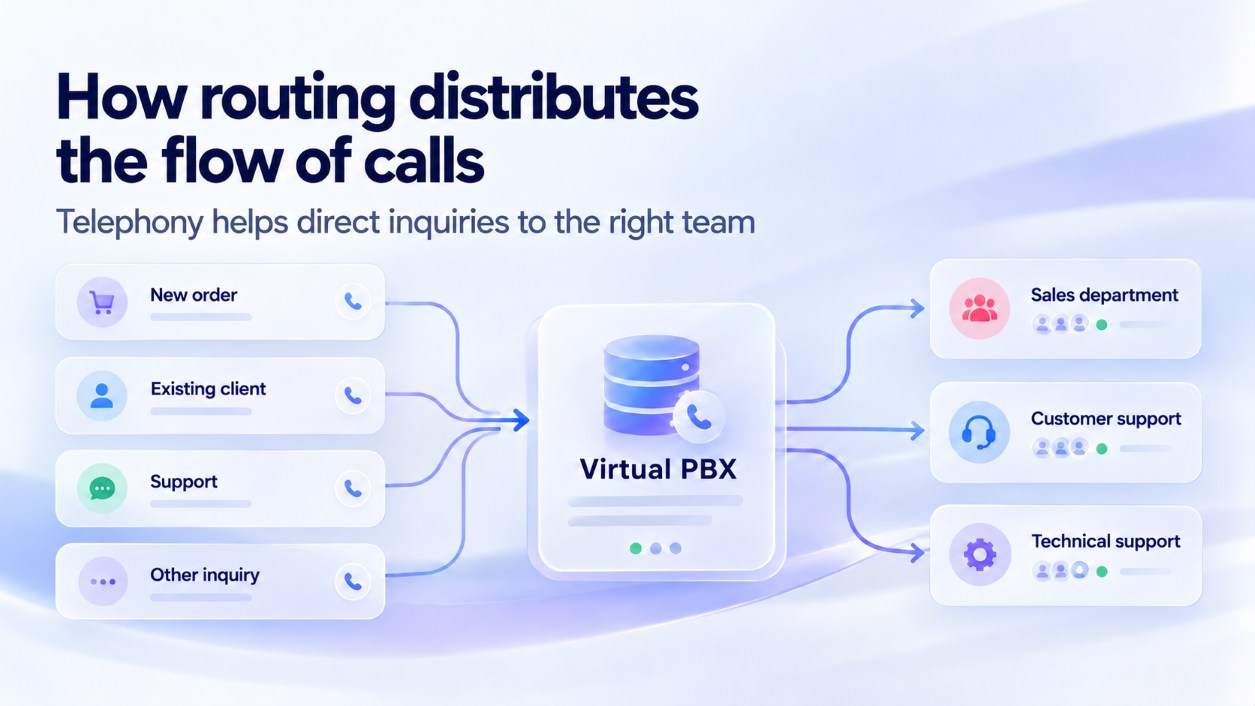
For example, requests about new orders, support for existing customers, and technical assistance may be handled by different teams. An interactive voice menu and configured routing rules allow calls to be directed to the appropriate departments without unnecessary transfers.
#image_title
The Stream Telecom virtual PBX supports multiple simultaneous call channels, call distribution rules, an interactive voice menu, call history, call recording, and analytics tools. For more advanced requirements, queue management and automated handling of missed calls are also available.
These tools make it possible to organize inbound call handling according to the company’s structure and reduce reliance on manual call distribution.
Monitoring Inquiries That Go Unanswered
Re-establishing contact with customers whose calls were not answered should be a separate process.
In Stream Telecom’s virtual PBX, missed calls are displayed in a dedicated section and remain active until a callback is made. This enables the company to monitor how these inquiries are handled rather than simply accumulating them in statistics.
However, for effective management oversight, additional rules should be defined: who is responsible for callbacks, how quickly they must be made, and how the outcome is recorded.
For example, a company can establish different response-time standards for new inquiries, existing customers, and requests with high commercial priority. These standards must reflect the team’s actual capabilities and be reviewed regularly based on performance results.
The main objective is to maintain control over the process even when the current workload temporarily exceeds the team’s ability to respond immediately.
Why Call Handling Does Not End When the Conversation Does
Telephony helps establish contact, but the subsequent outcome depends on how the information received is used. This is particularly important in complex sales, where days or weeks may pass between the first inquiry and the conclusion of a deal.
During this period, the sales representative conducts additional consultations, agrees on the terms of cooperation, prepares documents, and returns to discussing the offer. If the interaction history is stored separately from work tasks, it becomes harder for the manager to oversee the fulfillment of commitments.
That is why it makes sense to integrate telephony with a CRM system, where communication can be linked to a specific customer, deal, and next action.
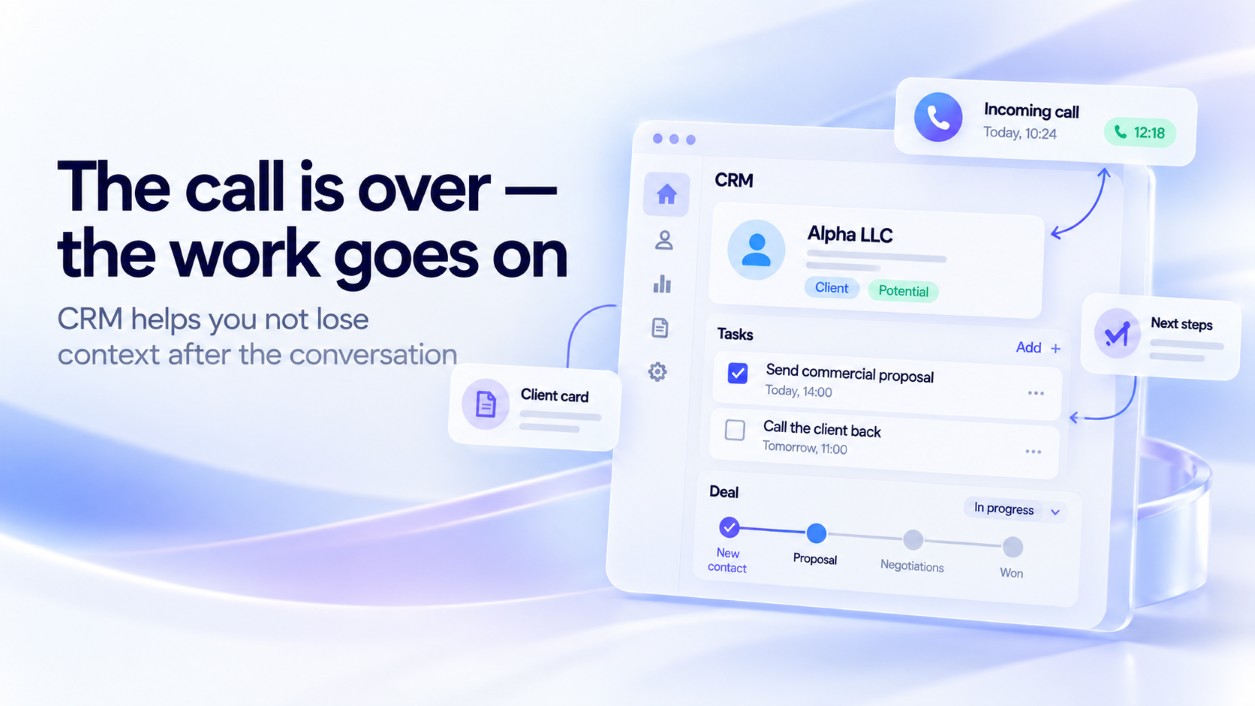
For example, Stream CRM brings together the customer database, deals, tasks, and telephone communication history. During a call, the system can automatically open the customer’s record, while a personal assistant for the sales representative compiles a list of scheduled actions and reminds them of necessary follow-ups.
#image_title
For a business, this creates an opportunity to oversee the entire inquiry-handling process. The manager can see not only the number of calls but also whether a responsible sales representative has been assigned, whether the next task has been completed, and what stage the deal has reached.
At the same time, the use of Stream Telecom telephony is not limited to the company’s own CRM system. Integration with other systems makes it possible to incorporate telephony into an established digital business infrastructure.
How Much Communication Overload Costs a Business
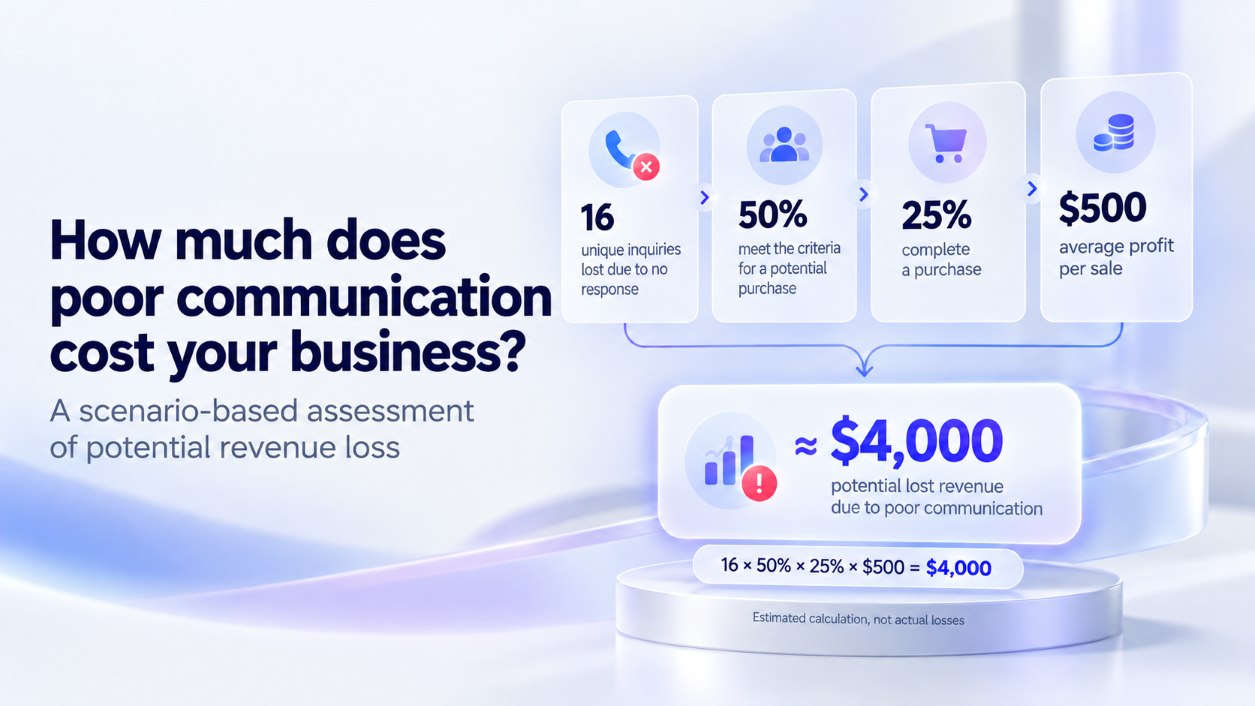
Operational problems have financial consequences, but these must be assessed carefully. It is not valid to multiply all missed calls by the average transaction value and treat the resulting amount as lost revenue.
Some inquiries may be repeat contacts or may not match the target audience. Some customers call again, while others receive a callback and continue interacting with the company.
For a more meaningful estimate, it is necessary to determine the number of unique potential inquiries for which contact could not be re-established and compare that figure with the historical conversion rate for similar inquiries.
Consider a hypothetical example.
Over one month, a company recorded 40 missed calls. After reviewing the records and making follow-up attempts, it found that some inquiries had been handled, while 16 unique potential inquiries remained without successful contact.
Suppose that:
- 50% of these inquiries could meet the criteria for a potential buyer;
- 25% of qualified inquiries typically result in a sale;
- the average contribution margin per deal is UAH 8,000.
The estimated financial result the company may have missed out on is calculated as follows:
16 × 50% × 25% × UAH 8,000 = UAH 16,000.
For example, if most losses are caused by uneven call distribution, it may be more practical for a company to adjust its routing rules and work schedules first, and only then consider increasing headcount.
Stress Testing Before Scaling: Is the Company Ready for Higher Demand?
Before launching a new advertising campaign, opening a regional branch, or expanding the sales department, it is worth checking how the existing system will perform under a heavier workload.
This analysis can be based on historical telephony and CRM data, supplemented by forecast scenarios. The key is to assess not only average inquiry volume but also possible deviations from normal operating conditions.
To do this, it is worth testing several scenarios:
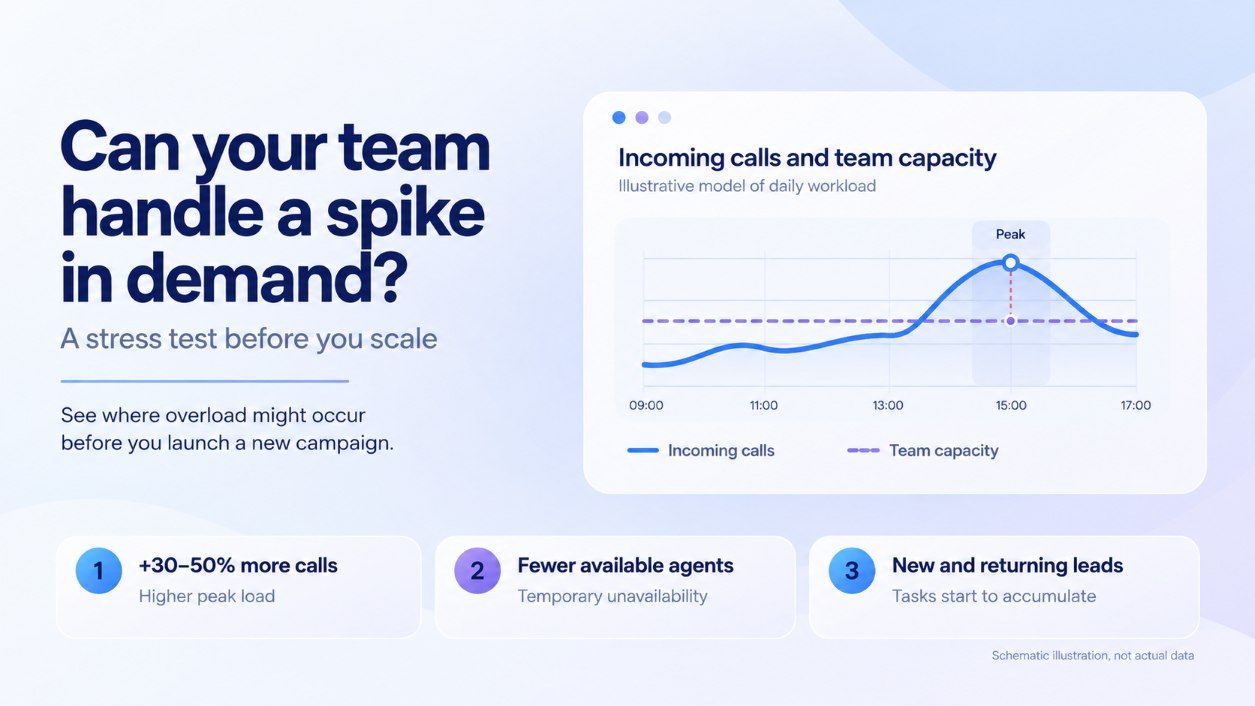
After modeling these scenarios, the company should identify critical indicators that signal when work processes need to be changed.
These signals may include a sustained increase in waiting times, an excessive share of unhandled inquiries, longer callback times, or systematic breaches of internal service standards.
To verify the effectiveness of changes, it is advisable to conduct a pilot implementation. For example, first modify call distribution rules in one department, compare performance before and after the changes, and then extend proven solutions to other teams.
It is important to distinguish the outcomes of technological changes from the effects of external factors. Changes in advertising traffic, seasonality, or the complexity of inquiries can affect performance metrics regardless of telephony settings.
Which Digital Solutions Do Businesses Need to Scale Communications?
Technology selection should begin by identifying the constraints holding back the company’s development.
If the main issue is uneven call distribution, the priorities will be routing, queues, and monitoring sales representatives’ workloads. If the team fails to follow through on commitments made during conversations, CRM integration, task automation, and monitoring of subsequent actions will be more important.
For companies with several departments, additional priorities include the scalability of telephony infrastructure, centralized administration, access controls, and the ability to analyze the results of individual teams.
This is why services should not be evaluated solely by their feature lists or prices. It is also necessary to consider the complexity of integration with existing systems, the need for additional configuration, administration costs, and options for future expansion.
One platform for choosing such solutions is Kyivstar B2B Marketplace. The platform brings together digital products from business partners and allows companies to compare their capabilities, pricing, and available integrations.
Among the solutions available on the Marketplace is the Stream Telecom virtual PBX, which helps organize telephone communications according to business needs. With flexible call routing, queue management, and missed-call monitoring, a company can distribute workloads more efficiently among sales representatives, reduce the number of unhandled calls, and maintain service quality as the flow of customer inquiries grows.
For comprehensive sales management, Stream Telecom also offers Stream CRM. The system brings together the customer database, communication history, deals, and work tasks. Combined with telephony, it enables companies to monitor not only how inquiries are received but also how they are handled afterwards — from the first conversation through to the completion of a deal.
The advantage of this approach is the ability to scale business communications without losing control over processes. Managers gain data to evaluate team performance, sales representatives get tools for systematic customer management, and marketers can link acquired inquiries to sales outcomes.
At the same time, Stream Telecom solutions can be implemented gradually. Companies that already use a CRM system can integrate cloud telephony with it, while businesses planning comprehensive automation can combine both products into a single system.
A 14-day trial period is available for the virtual PBX and Stream CRM. This is an opportunity to test the services using real business processes, assess how well they meet the company’s needs, and establish a technological foundation for further scaling.
The main objective when scaling is not simply to increase the number of available channels or workstations, but to ensure that inquiry volume, team resources, and work organization are aligned. This creates the conditions under which growth in demand can translate into sustained improvements in business results.