How Businesses Can Prepare for Black Friday 2026: Trends, Channels, and a Communication Plan
Companies prepare discounts, banners, and ad campaigns well in advance, but communication with their customer base is often only remembered the day before Black Friday. By that point, some shoppers have already chosen their products, compared offers, and their phones and inboxes are already full of competitors’ messages.
Black Friday has long stopped being a single day. Shoppers start planning purchases weeks in advance, expect early access to deals, and keep buying after Cyber Monday. That’s why a business doesn’t need one mass mailing — it needs a consistent communication scenario before, during, and after the sale.
Black Friday isn’t won by the business that sends the most messages, but by the one that offers the customer a relevant reason to buy at the right moment.
The Black Friday season starts well before the sale
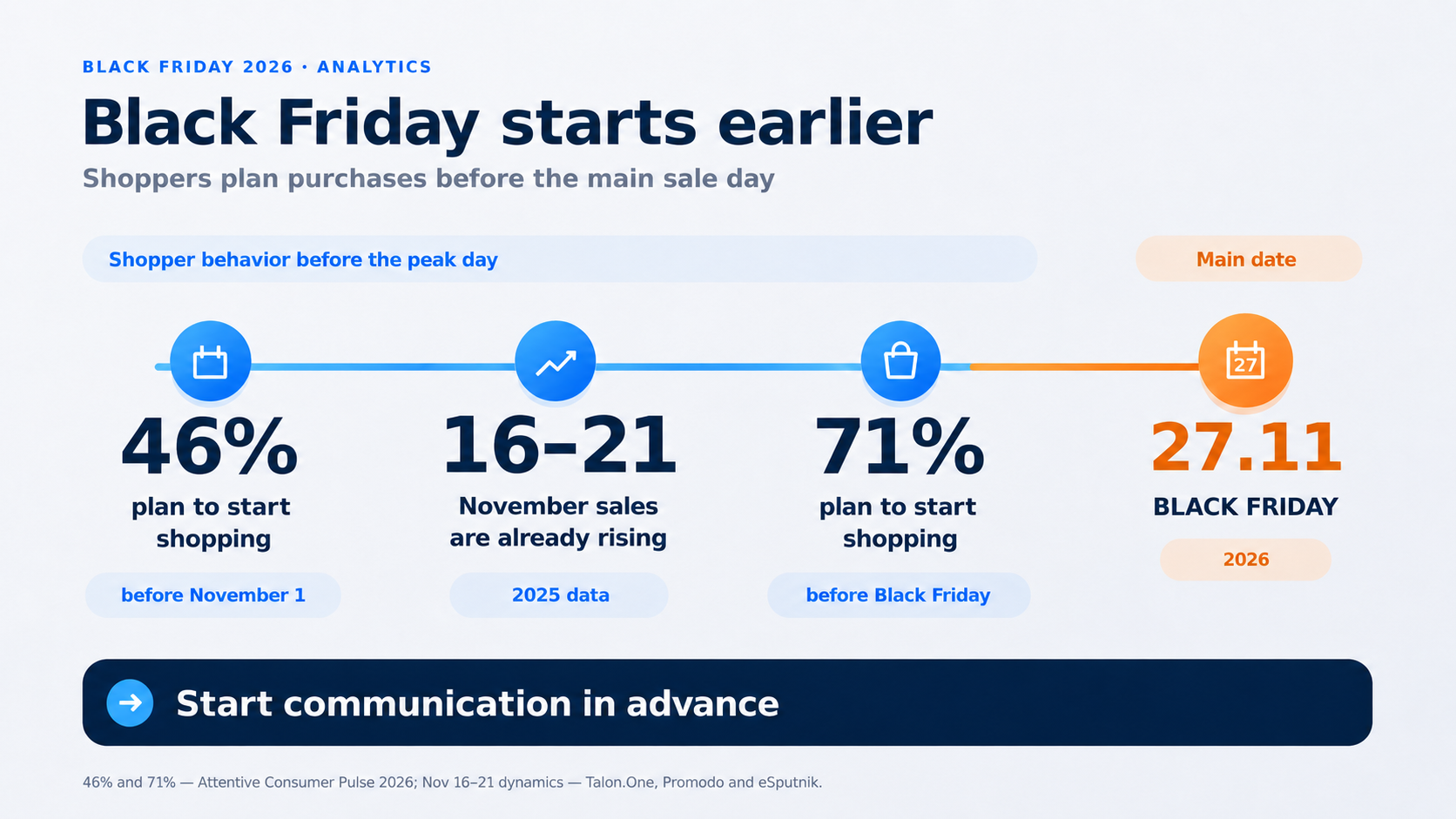
In 2026, Black Friday falls on November 27, but communication with customers needs to start much earlier.
The seasonal sale period is gradually expanding. According to Talon.One data cited by Marketing Dive, in 2025 sales tied to personalized promotions and special offers already started growing on November 16 — almost two weeks before the traditional peak. Some brands launched their first offers as early as the start of the month, and early-access programs for loyal customers as early as October.
Shoppers themselves are also preparing ahead of time. According to an Attentive survey, 71% of American consumers planning to shop during Black Friday and Cyber Monday in 2026 will start shopping before Black Friday, and 46% will start before November even begins. Even if people aren’t placing orders yet, they’re already comparing prices, making lists, and choosing brands.
Ukraine shows a similar trend. Research by Promodo and eSputnik found that in 2025 demand began forming well in advance, with sales steadily rising from November 21 onward. The peak days were Black Friday itself and the Monday before it.
For businesses, this means waiting for Black Friday itself is too late. The first messages need to go out while customers are still planning their purchases: getting familiar with upcoming offers, making lists, and deciding which brands deserve their attention.
Shoppers aren’t looking for the maximum discount alone
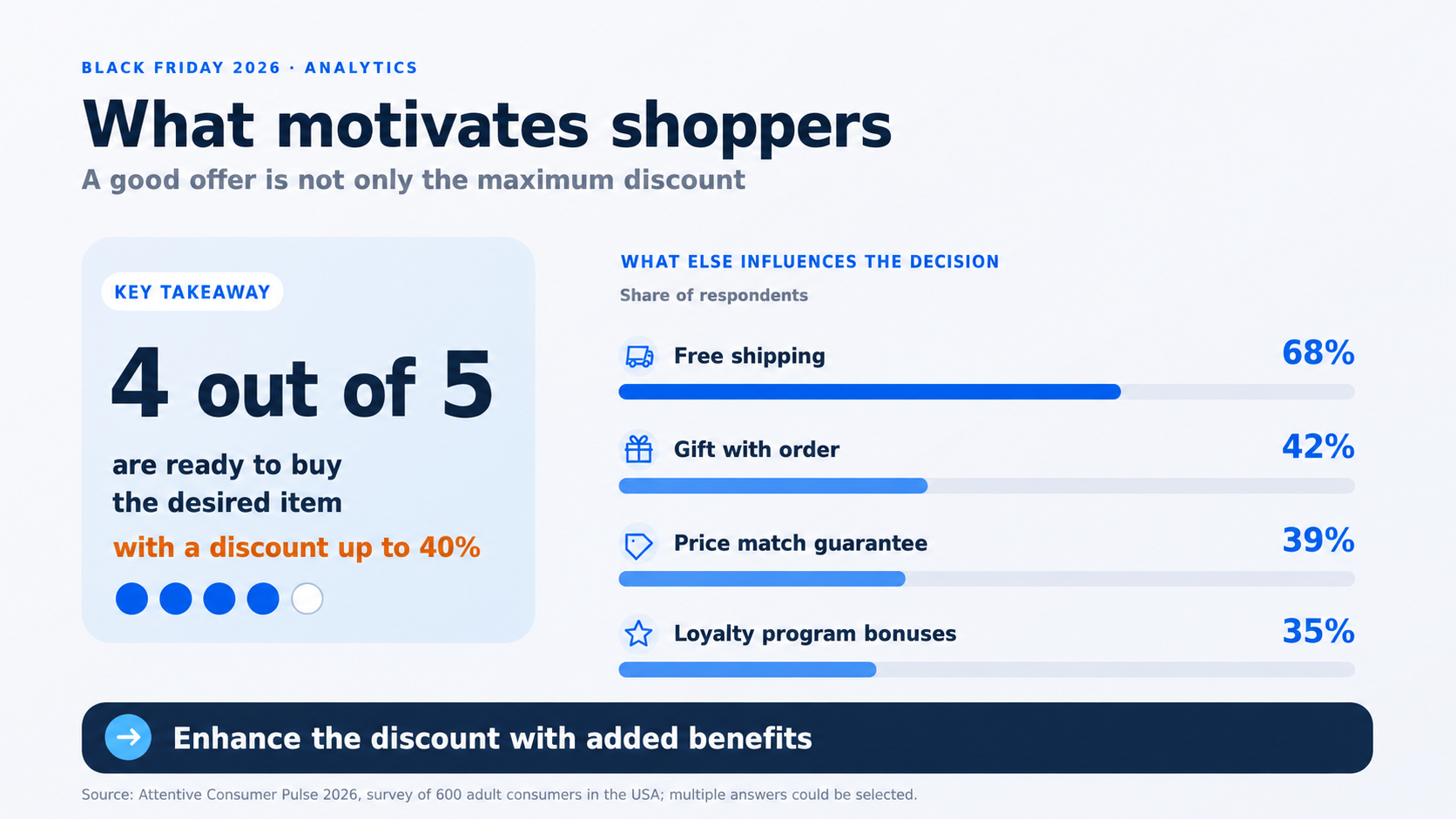
A large percentage grabs attention, but doesn’t always determine the purchase decision. According to Attentive, four out of five respondents are willing to buy a desired item at a discount of no more than 40%. For 45%, a discount of 20–40% is enough; for 25%, less than 20%; and 10% would buy even without one.
Additional perks matter just as much. Among the conditions that can motivate a buyer besides a discount, 68% of respondents named free shipping, 42% named a gift with purchase, 39% named a price-match guarantee, and 35% named extra loyalty program bonuses. This gives businesses room to build appealing offers without excessively cutting prices.
At the same time, shoppers are more cautious about loud promotions. According to DHL, only 50% of respondents across various countries fully or mostly trust retailers’ prices and offers during Black Friday. That’s why a promotional message needs to immediately clarify:
- which products the offer applies to;
- how long it’s valid;
- exactly what benefit the customer gets;
- whether free shipping, a gift, or extra bonuses are included;
- where to go to place the order.
During Black Friday, it’s not enough for shoppers to see a big percentage — they need to quickly understand the terms and be confident the offer is genuinely worthwhile.
The mobile phone becomes the main point of contact
Most customers not only receive promotional messages on their phones — they go straight from there into the catalog and place an order. According to Salesforce, mobile devices accounted for 70% of online orders worldwide during Cyber Week 2025.
In Ukraine, this figure is even higher. According to research by Promodo and eSputnik, in November 2025 the share of purchases made from smartphones grew from 75% to 78% compared to the previous year. This means the path from message to completed order needs to be as short and convenient as possible.
To ensure this, it’s worth checking in advance:
- whether the main offer is clear from the first lines of the message;
- whether the link leads directly to the promotional product or collection;
- whether the page displays correctly on a smartphone;
- whether the promotion’s terms, duration, and shipping cost are easy to find;
- whether the order can be placed and paid for quickly from a mobile device.
Even an attractive offer may not lead to a purchase if the customer has to search for the promotional item, zoom in on small text, or re-enter data. That’s why SMS, Viber, and other mobile channels need to be part of a single, convenient customer journey — not just a way to announce a discount.
How to build communication before, during, and after Black Friday
A single message can’t simultaneously spark interest, explain the terms of a promotion, and convince the customer to place an order. That’s why communication should be split into several stages, each with its own task.
2–4 weeks before Black Friday
At this stage, the goal is to draw attention to the upcoming sale and help customers prepare to buy. There’s no need to reveal the biggest discount right away. You can:
- announce the sale’s start date;
- announce the categories on sale;
- offer early access to loyal customers;
- invite customers to subscribe to price-drop alerts;
- let customers save items in advance or build a wishlist;
- provide a personal promo code.
Early messages help a brand get onto a shopper’s shortlist before competition for their attention peaks.
A few days before the sale starts
Once the customer already knows about the upcoming sale, it’s time to move from a teaser to a concrete offer. The message should show the discount size, the products on sale, the duration, and any additional terms.
Segmentation is especially important at this stage. Someone who previously bought children’s products should be shown a relevant selection, while a customer who hasn’t ordered in a while should be offered a separate win-back promo code.
A personalized message has a better chance of grabbing attention than a general announcement of discounts across the entire assortment.
On Black Friday itself
On the day of the sale, customers receive many similar offers, so the message needs to be short and specific. It’s appropriate to remind them that:
- the sale has already started;
- their personal promo code is active;
- a popular item is back in stock;
- only a few hours remain until the offer ends;
- the promotional item is in limited supply.
Don’t resend the same message to people who have already used the offer. After a purchase, it’s better to move the customer into a different scenario: thank them for the order, update them on its status, or suggest a relevant complementary product.
After Black Friday
Some shoppers keep looking for deals after the main sale ends. Communication can continue with messages about Cyber Monday, the last day of the promotion, an unused promo code, or products the customer viewed but didn’t buy.
If a company continues offering discounts, this needs to be explained honestly, with a new deadline stated clearly. Repeated “last chance” messages that keep getting extended erode trust in the brand.
Each stage should move the customer toward the next action: first spark interest, then help them choose, remind them of the offer at the right time, and continue the conversation after the purchase.
Which channels to use during Black Friday
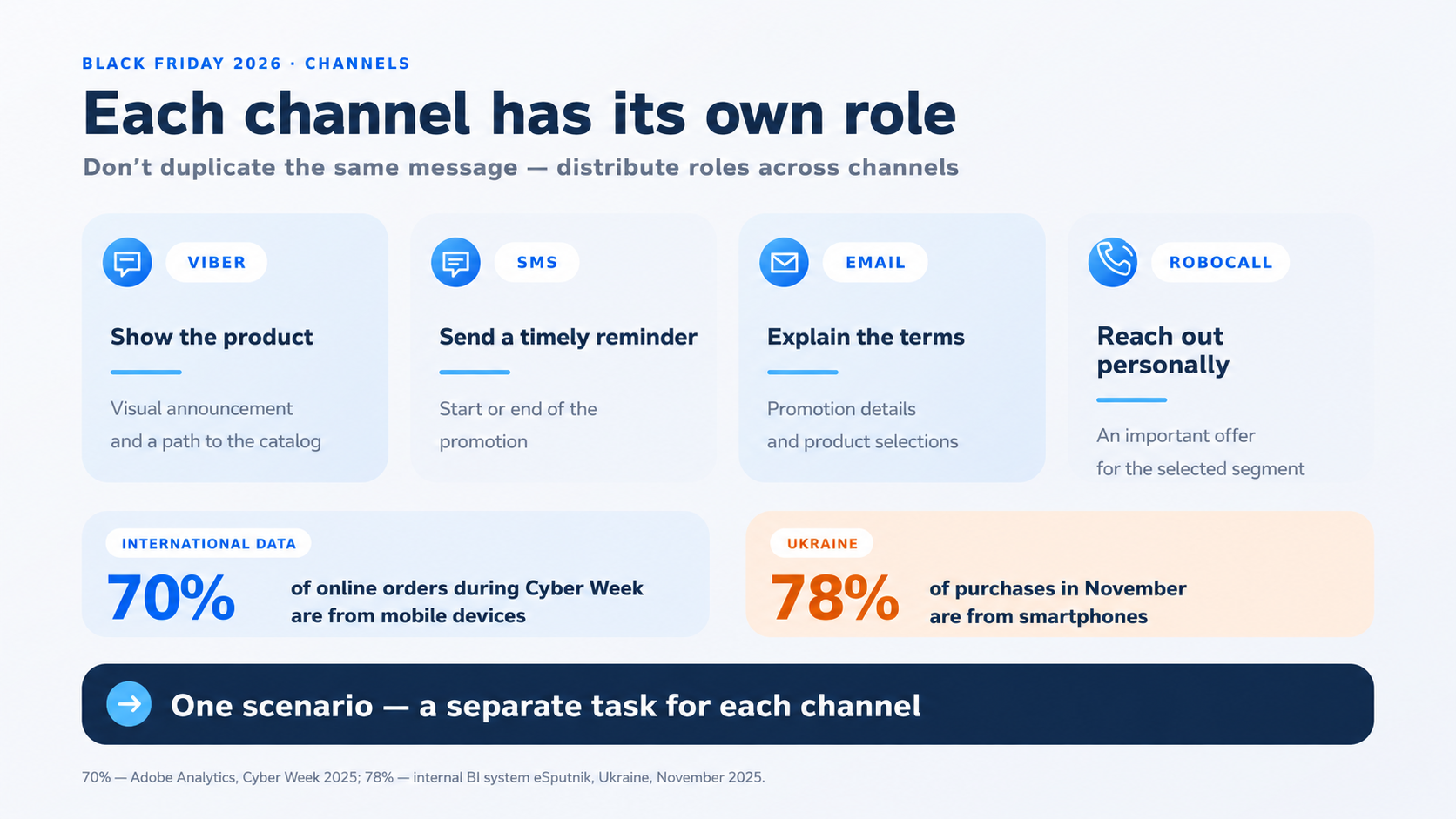
Each channel should perform a distinct task within the overall communication scenario. Viber is good for showcasing an offer, SMS for a quick reminder, email for going into more detail, and automated voice calls for reaching selected customer segments.
Viber messaging: when you need to show the offer
Viber works well for the main visual announcement of Black Friday. A message can include an image, a short description of the offer, a call-to-action button, a link, and a branded sender name. Customers immediately see the product or promotional selection and can move straight to purchase.
Viber messaging is a good fit when you need to:
- present the main Black Friday offer;
- showcase a selection of discounted products;
- give loyal customers early access;
- announce a personal discount;
- draw attention to limited stock;
- send the customer directly to the catalog or checkout.
According to Promodo and eSputnik, Viber communication delivered the best results on Black Friday 2025. That makes the channel especially well suited for the main message on the day the sale starts.
Avoid overloading a Viber message with multiple banners, long text, and several buttons. It’s better to use one eye-catching image, state the key benefit briefly, mention the offer’s duration, and add a clear button such as “View products,” “Get the discount,” or “Buy now.”
SMS messaging: when you need to inform quickly
SMS works best for short, urgent messages the customer can grasp in a few seconds. This might be a reminder that the sale has started, a personal promo code, notice that a popular item is back in stock, or a warning that the offer is about to end.
An effective Black Friday SMS should include:
- the brand name;
- one specific offer;
- its duration;
- a promo code, if applicable;
- a direct link to the promotional item or collection.
For example:
[Brand]: Black Friday has started. Up to 30% off selected items until 11:59 PM. View offers: [link]
Don’t try to fit several different promotions, detailed terms, and a long list of products into a single SMS. If the offer needs more explanation, keep the main benefit and a link to a page with full details in the message.
Email: when you need to say more
Email is well suited for presenting a promotion in detail: it can show several product categories, explain the terms, include curated selections, and answer common questions. Email is worth using during the preparation stage, when shoppers are comparing offers, as well as after Black Friday for Cyber Monday messages and to continue the seasonal campaign.
According to Promodo and eSputnik, because of the sheer volume of emails sent during Black Friday 2025, users opened them less often, and most email click-throughs happened on Cyber Monday. That’s why it’s unwise to rely solely on email on the main sale day. A short subject line, a clear offer, a mobile-friendly layout, and pairing email with Viber or SMS all improve the odds of catching a customer’s attention in time.
Automated voice calls: for important offers and select segments
A voice message draws more attention than a plain text one, but it needs to be used selectively. A mass call to the entire customer base with the same offer can come across as intrusive. Automated calls work well, however, for loyal customers, loyalty program members, or shoppers who have previously shown interest in a specific product category.
The RoboCall auto-dialer places calls automatically based on set criteria, retries if the customer doesn’t answer, and collects statistics. No operator involvement is needed.
A voice message can be used to:
- invite loyal customers to an early sale;
- announce a personal offer;
- remind customers that a sale is starting or ending;
- inform customers that an awaited product is back in stock;
- highlight special terms for loyalty program members.
The recording should be short: the company name, the reason for the call, the main benefit, and the offer’s duration. Detailed terms are better sent separately via SMS or Viber with a link.
Automated calls should only be made to segments who would genuinely find the offer relevant, and at a reasonable time of day. This helps deliver important information without turning the voice channel into just another source of mass advertising.
How not to get lost among 121 million messages
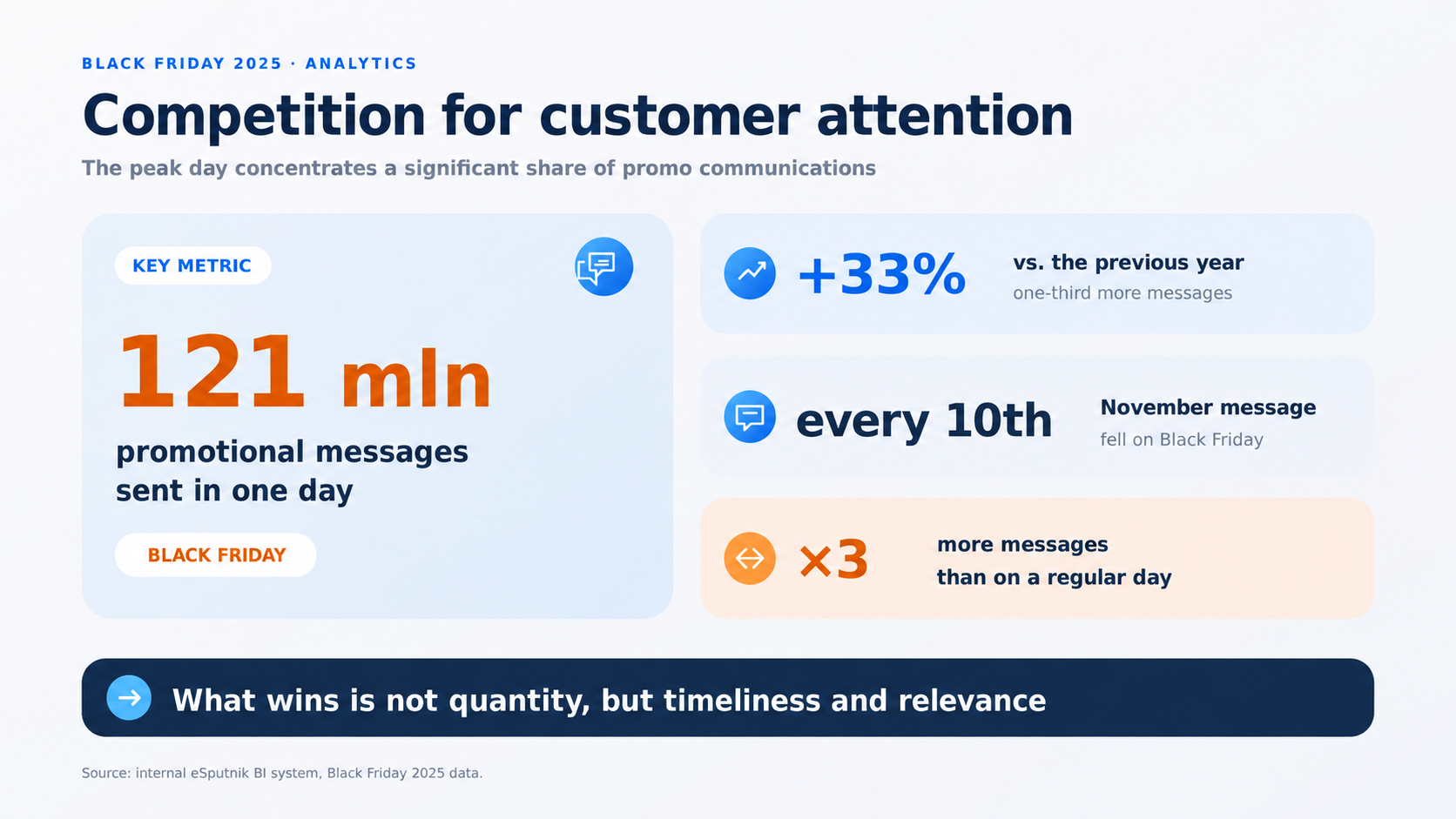
According to Promodo and eSputnik, 121 million promotional messages were sent on Black Friday 2025 — a third more than the previous year. One in every ten messages sent during the entire month of November went out on that single day, and total message volume was three times higher than on an ordinary day.
Given that level of competition, sending more messages doesn’t guarantee a customer will notice the offer. Excessive frequency, identical text across channels, and irrelevant promotions can, on the contrary, cause irritation.
To keep communication from turning into noise, it’s worth:
- segmenting customers by past purchases, interests, and activity;
- assigning a distinct task to SMS, Viber, email, and voice messages;
- not duplicating the same offer across all channels at once;
- formulating one core benefit and one target action;
- linking directly to a specific product or promotional selection rather than the homepage;
- not repeating messages to customers who already placed an order;
- limiting contact frequency and accounting for the timing of previous messages;
- using only the contacts of customers who consented to marketing messages.
Multichannel doesn’t mean sending the identical promotion via SMS, Viber, email, and a phone call. Each channel should carry out its own task within a shared scenario.
What metrics to evaluate after the campaign
The number of messages sent shows the scale of a campaign, but not its outcome. To understand which channels and offers actually drove sales, you need to analyze the entire customer journey — from receiving the message to placing the order.
After Black Friday, it’s worth evaluating:
- delivery rates — what share of SMS, Viber messages, and calls reached recipients;
- click-through rates — which messages generated the most interest;
- promo code usage — how many customers used a specific offer;
- conversion to orders — what share of clicks turned into a purchase;
- revenue by channel — how much SMS, Viber, and other channels contributed to sales;
- average order value — whether bundles, gifts, or threshold discounts affected order size;
- performance by segment — how new, returning, and inactive customers responded;
- unsubscribes and complaints — whether message frequency was excessive;
- repeat purchases — how many customers came back after the main sale ended.
For accurate analysis, separate links with UTM tags or promo codes for different channels and segments need to be prepared before the campaign launches. If customers can place orders by phone, call tracking should also be set up. It helps identify which message, ad channel, or campaign drove each call.
Without this kind of tracking, a business will see overall sales growth but won’t be able to pinpoint how much of it came from SMS, Viber, or other channels. The data collected will help not only sum up Black Friday results but also identify which offers and scenarios are worth using in future promotional campaigns.
Black Friday 2026 preparation checklist
To avoid dealing with organizational and technical issues in the final days before the sale, preparation should start well in advance. Before launching the campaign, check that the key steps are in place:
- Define the campaign period. Plan not just Black Friday itself, but also the earlier teasers, Cyber Monday, and communication after the main sale ends.
- Formulate the offer. Lock in the discount size, product list, dates, exclusions, shipping terms, and additional perks.
- Check the customer database. Remove outdated contacts and confirm recipients have consented to receive marketing messages.
- Segment the audience. Prepare separate offers for new, returning, and inactive customers, as well as for buyers of different product categories.
- Define each channel’s role. For example, use Viber for the visual announcement, SMS for a quick reminder, and automated calls for important offers to selected customers.
- Prepare the message scenario. Write the texts in advance for the announcement, sale launch, end-of-sale reminder, and post-purchase communication.
- Check the path to purchase. The promotional page should work correctly on a smartphone, and links should lead directly to the right product or collection.
- Test the technical setup. Check promo codes, buttons, links, order forms, payment, and how messages display on different devices.
- Set up analytics. Add UTM tags, separate promo codes, and call tracking.
- Plan for scenario changes. Stop promotional reminders after a purchase, notify customers when stock runs out, and don’t recommend products that are no longer available.
This checklist will help tie the offer, communication channels, and analytics into a single scenario before the peak season begins.
Black Friday 2026: prepare your communication in advance
On the peak day, there won’t be time left to check the database, fix links, or set up analytics. That’s why the communication scenario, channels, and results tracking need to be ready before the sale begins.
The Stream Telecom team can help you choose and configure the tools for your promotional campaign, so your business enters the high season with a ready-made communication system rather than a set of last-minute fixes.