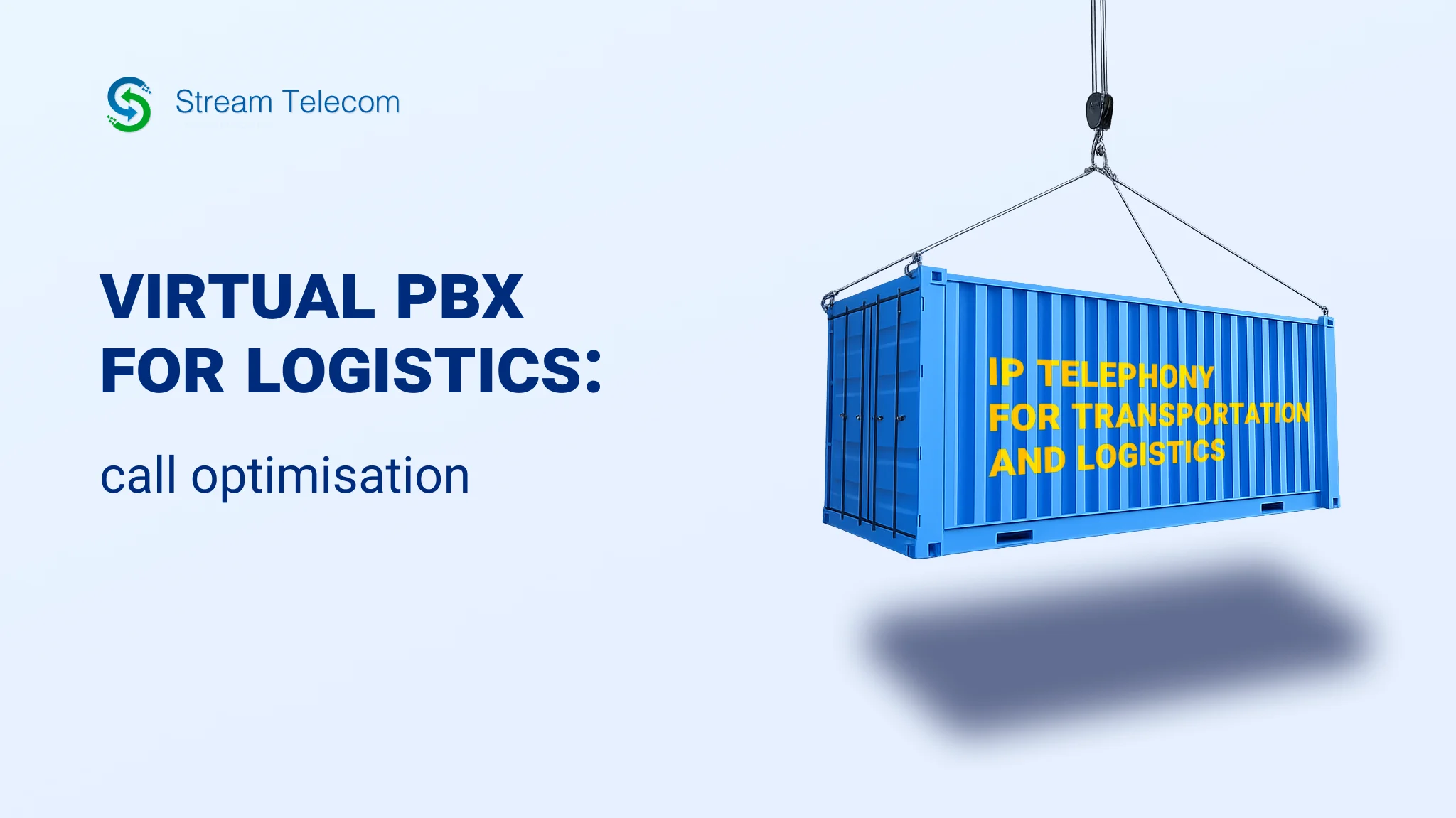
A virtual PBX for a logistics company functions as an operational backbone. Call flow comes from multiple sources: customers, drivers, freight forwarders, warehouses, contractors, and delivery services. Without a unified routing scheme, calls scatter across personal numbers, get lost outside business hours, and land on overloaded staff. Managing driver communications becomes especially difficult during peak loads. The dispatch center handles dozens of calls simultaneously while tracking routes, flight statuses, address changes, and vehicle scheduling. Without centralized control, it is nearly impossible to monitor shift workloads, call durations, missed contacts, and retry attempts.
How a Virtual PBX Solves These Problems
Dispatch automation moves telephony into a unified cloud infrastructure. All incoming channels pass through a central number, and the system applies distribution rules based on queue, priority, department, time of day, operator status, and request type. Virtual communications run on SIP trunks, ACD logic, IVR trees, call recording, event logs, API integrations, and analytical reports. The dispatcher sees each call the moment it arrives, the supervisor receives queue and missed-call statistics, and data flows directly into the CRM or TMS.
Key Use Cases for a Virtual PBX in Logistics
IP telephony for transport and logistics serves as a communication hub. It distributes incoming calls, automates initial navigation, records conversations, and collects analytics on inquiry sources.
Call Distribution Among Dispatchers The queue and routing mechanism defines how each call is handled. The system checks operator availability, area of responsibility, wait time, customer priority, and current load — then connects the call to a free dispatcher. Load balancing is a real-time dispatch tool: no single operator accumulates a critical volume of requests, and the system evenly distributes the flow across all active lines.
Voice Menu for Customers and Partners An IVR voice menu for logistics performs initial call segmentation before a human is involved. The caller selects an option via keypad or voice navigation, and the system routes them to the appropriate department: delivery tracking, new order, accounting, contractor management, or technical support. IVR reduces the time to the first meaningful action — the operator receives a structured request rather than a generic call with no context, which is critical in logistics where every inquiry is tied to a specific shipment or route.
Monitoring Driver and Staff Calls Call recording combined with the event log creates a complete communication trail. It is easy to verify when a call came in, how long it lasted, and to whom it was forwarded. Call analytics reveal recurring errors, processing delays, and peak load periods. Recordings make it straightforward to assess script compliance, data handoff quality, and response speed when a route changes or a delivery incident occurs.
CRM and Logistics System Integration Telephony–CRM integration links each call to the customer record, order, and shipment. When an inbound call arrives, the dispatcher sees the number, contact history, active requests, delivery status, and previous incidents. Synchronization with logistics platforms eliminates duplicate data entry: the call event, conversation outcome, status update, and operator comment all go into a single unified record.
Automated Customer Notifications Automated notifications work as part of the operational chain. The system sends order confirmations, departure alerts, status updates, arrival notifications, and rescheduling notices. Delivery channels — voice, SMS, messengers, or email — depend on configuration. These notifications remove a portion of routine calls from the dispatch queue: customers receive current status updates without needing to call in, and staff do not spend time repeating standard information.
Call Tracking for Advertising Effectiveness Call tracking ties every call to a specific acquisition channel. The system records the traffic source, campaign ID, landing page, time of inquiry, and subsequent lead action — creating a direct link between ad spend and actual inquiries. In a logistics company, this analytics layer is useful beyond the sales team: it shows which channels generate freight requests, where traffic converts into commercial contacts, and where losses occur at the call stage.
How a PBX Improves Dispatch Efficiency
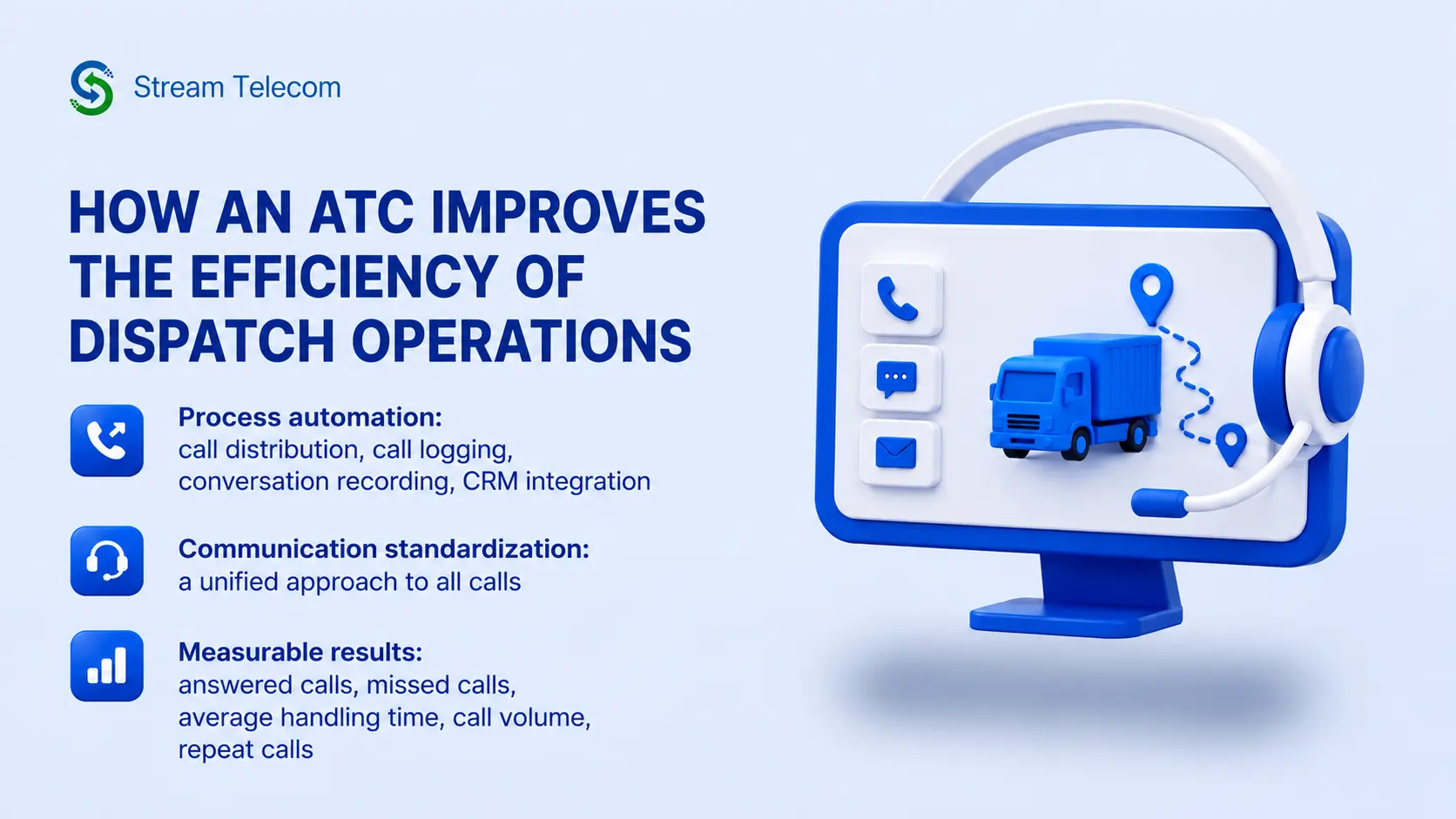
Omnichannel communication removes a range of manual operations from the dispatcher’s workflow. Call distribution, logging, recording, customer card lookup, and CRM data transfer all happen automatically, reducing the time between a call arriving and processing beginning.
Standardizing the multi-channel number delivers an additional benefit: every call follows the same logic — routing, caller identification, outcome recording, and history storage. Operational metrics become measurable: average response time, missed call rate, call duration, shift workload, and repeat contacts on a single order.
Impact on Customer Service in Logistics
For the customer, dispatcher performance defines how the entire company is perceived. A fast answer, accurate transfer, and correct information about a shipment or delivery create the impression of a well-organized service. A virtual PBX brings service up to the operational level: the customer gets a clear path to the right person, the operator sees the history of previous interactions, and delivery status is communicated without repeated explanations.
How to Choose a Virtual PBX for a Logistics Business
Before optimizing call handling in logistics, the key parameters should be analyzed.
Selection criteria:
- Reliability — continuous telephony operation during business hours and under peak load
- Integrations — connectivity with CRM, TMS, ERP, and other management systems
- Scalability — fast provisioning of new numbers, groups, and users
- Analytics — reports on calls, queues, missed contacts, and inquiry sources
For a logistics company, technical compatibility matters more than surface-level service features. The solution must integrate seamlessly into the existing IT architecture.
Start Optimizing Your Logistics Calls Today
To find out how to stop losing calls in logistics, contact Ukrainian provider Stream Telecom. A virtual PBX brings a logistics company’s communications into a managed technical model — calls, queues, recordings, notifications, integrations, and analytics all consolidated into a single system where every event is captured and processed according to defined rules. Get in touch for a consultation — we will run a test and launch the system tailored to your operational structure.