What Is SIP Telephony and How It Works
SIP telephony transmits voice over the internet. For a company, this means optimized communication costs and improved business communications. Instead of a dedicated telephone line, a data transmission network is used. The voice signal is encoded, travels through the internet, and is restored on the receiving end. SIP is responsible for establishing, maintaining, and terminating connections. A number works on an IP phone, a computer, and a mobile app. A single channel serves an office, remote employees, and branches in different cities. There is no tie to a specific fixed location.
What Is Traditional Telephony and Its Limitations
The drawbacks of analog telephony stem from its reliance on copper lines, switching equipment, and physical number binding. Every connection requires a cable, a port, station configuration, and technical support. Expanding the network entails additional infrastructure costs. The setup works for basic communication but is weak when it comes to scaling. New workplaces, offices, and sales directions each require separate connections and technical work. Changing call handling logic takes time. Call control is split between hardware, contractors, and separate services.
Key Advantages of SIP Over Traditional Telephony
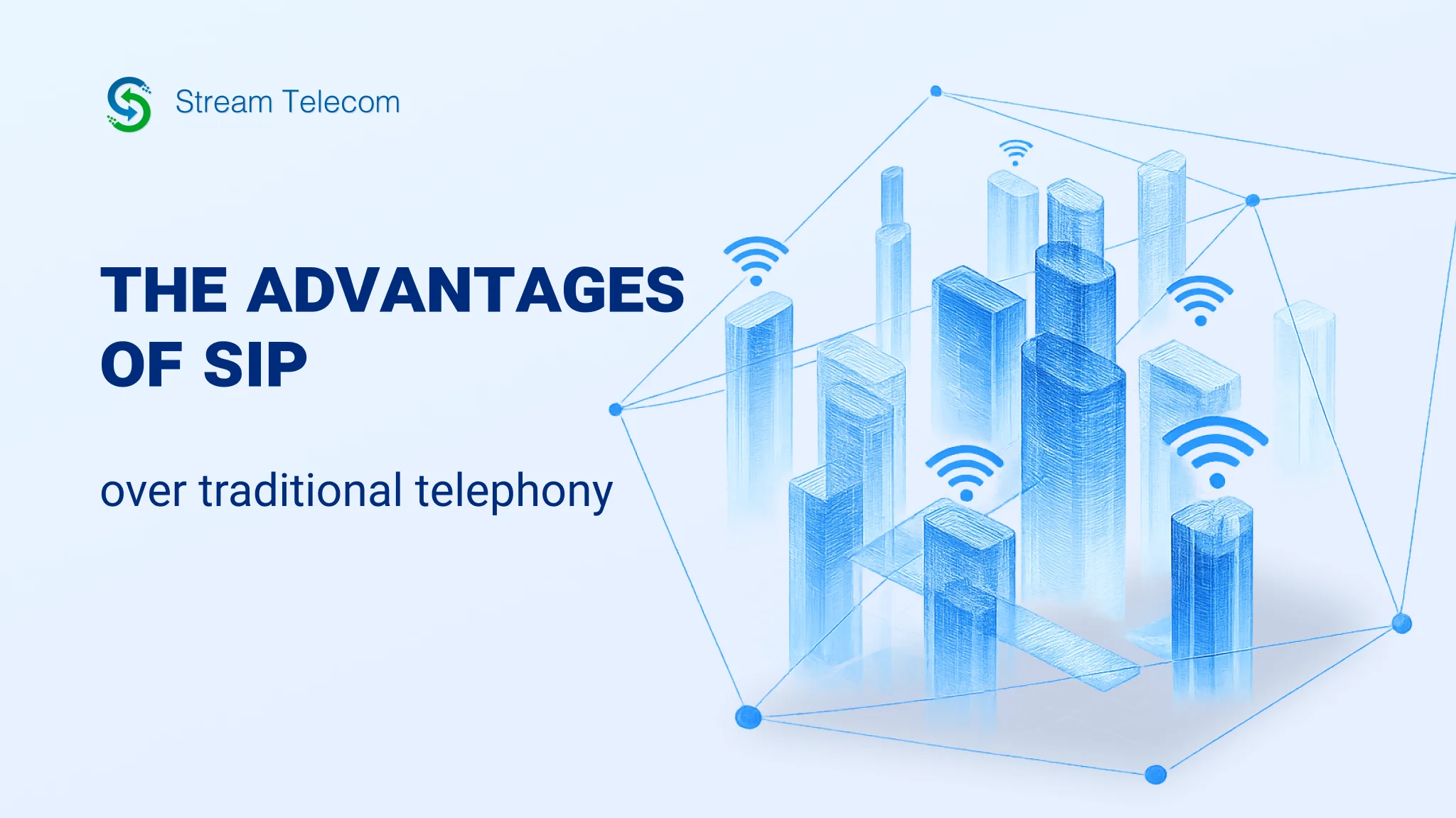
The advantages of SIP telephony lie in removing dependence on the physical telephone network. Communication is managed through a software platform, numbers are added without cable work, and routing is configured centrally. For a business, this means lower costs, faster expansion, and better control over communications.
Flexibility and Scalability
A new user connects via an app or IP services. SIP telephony scaling is done through the control panel. A new office is connected without a separate telephone exchange. Redistribution of internal subscribers, queues, and call reception scenarios happens without touching the cable infrastructure.
Mobility and Remote Work
Calls can be accessed from a laptop, smartphone, or tablet. The employee is not tied to the office. A single number works while traveling, at home, or when changing locations. Client contact is maintained without reconfiguring the line.
CRM and Business System Integration
SIP integration with CRM, Helpdesk, and ERP is carried out remotely. A call is automatically linked to the client’s profile, the request is logged in the history, and the manager sees previous interactions. This reduces manual work and speeds up request handling.
Advanced Functionality
SIP systems support IVR, call recording, call queues, forwarding, distribution by department, reporting, and load analytics. These are the core reasons businesses migrate to IP telephony. Every feature operates through a single platform, simplifying call monitoring, operator performance review, and the configuration of request handling algorithms.
Reliability and Redundancy
Connection stability is ensured by backup channels, server duplication, automatic call redirection, and fallback routes. During partial infrastructure failures, calls are transferred to another number, a mobile app, or an on-call group. The telephony system does not go down due to a single point of failure.
SIP vs. Traditional Telephony: Key Criteria Compared
IP telephony and traditional telephony differ in how they work, their costs, and their manageability. In the first case, communication lives within a software infrastructure. In the second, it depends on lines, hardware, and physical connections.
Key differences:
- Cost. SIP offers lower expenses for setup, number connection, and maintenance. In the traditional model, costs grow alongside lines, offices, and equipment.
- Flexibility. The advantages of cloud telephony for business lie in its ability to support rapid changes to operating schemes without installing additional cable lines. Traditional telephony is tied to its infrastructure.
- Scalability. New users, departments, and branches are added quickly. The old model requires technical intervention.
- Functionality. SIP provides IVR, call recording, analytics, routing, and integrations. In the traditional model, some features are absent or only available as separate modules.
- Control. In SIP, all settings and statistics are consolidated in a single panel. In traditional telephony, control is fragmented across different infrastructure elements.
These parameters clearly highlight why SIP outperforms analog telephony — and why it suits companies with high call volumes, multiple departments, remote teams, and variable structures.
Which Businesses Benefit Most from SIP Telephony
Telephony without a physical line is more effective in day-to-day operations.
E-commerce uses it for order processing, delivery confirmation, client communication, and returns. Logistics relies on it for coordinating drivers, warehouses, dispatchers, and partners. A unified number and centralized call distribution simplify operations without unnecessary channel switching.
The call quality of SIP telephony is especially felt in call center operations. They gain tools for queuing, call recording, load monitoring, and reporting. Service companies use SIP to receive and route requests to the right department, log contact history, and quickly transfer calls between specialists. For multi-location businesses, a cloud PBX is convenient due to its unified communication logic across multiple branches.
Common Mistakes When Switching to SIP
Transition mistakes are usually related to preparation and can negate the cost savings SIP offers — sometimes even leading to additional expenses.
Typical mistakes:
- Wrong provider choice — weak network, limited support, missing features, no SLA
- Lack of integrations — telephony operates separately from CRM, requests are processed manually, and some contacts are lost
- Neglecting analytics — no comparison of load data, missed calls, or operator performance
To avoid these mistakes, it is important to understand what SIP is and how call routing works through a virtual network. After launch, regular review of statistics, queues, recordings, and call distribution is essential. Without this, the system works — but never reaches its full potential.
How to Switch to SIP Telephony Without Business Disruption
A virtual SIP PBX is a solution for effective business growth. The transition begins with an audit: call volume, active numbers, working groups, communication channels, integrations, and load points. A platform is then selected, compatibility with CRM is verified, a connection scheme is chosen, and a migration plan is drawn up. It is best to launch the system in stages — starting with a test group, then rolling out to other departments.
Step-by-step implementation:
- Audit — analyze the existing telephony setup, load, number resources, and call structure
- Solution selection — compare providers, pricing plans, management tools, redundancy options, and support quality
- Integration — connect CRM, configure call recording, queues, routing, and reports
- Testing — verify audio quality, latency, call distribution, operator actions, and number functionality
After launch, it is worth keeping a backup communication scenario in place and periodically reviewing the settings.
Start Benefiting from SIP Telephony Today
SIP is the future of business telephony. The service is suited to companies where communication directly impacts sales, support, and logistics. Contact Stream Telecom. A consultation, a service demonstration, and a trial period will help you evaluate the solution in practice.