What Is SIP Telephony, How Does It Work, and What Benefits Does It Offer Businesses?
A single business phone number can connect dozens of employees across different cities. Handling calls no longer requires installing an on-premises PBX or running separate telephone lines. IP telephony, particularly the use of the SIP protocol, has made this possible.
SIP telephony gives companies greater flexibility in organizing their communications: employees can answer calls on different devices, work outside the office, and stay connected with customers through business phone numbers. In this article, we explain how it works, how SIP differs from VoIP, what benefits it offers businesses, and what to consider before getting started.
What Is SIP Telephony?
SIP telephony is a telephone communication technology that allows users to make and receive calls over the internet. It is based on SIP (Session Initiation Protocol), which is responsible for establishing, managing, and terminating telephone connections. This allows companies to set up business communications without running separate telephone lines to every workstation.
To communicate with customers, employees can use a computer with a headset, a smartphone with a dedicated app, or a desk IP phone. Customers simply dial the company’s regular landline or mobile number; they do not need to install any additional software.
SIP telephony can also be connected to a Virtual PBX to bring employees from different offices into one telephone system, configure call distribution, and use additional features for managing customer communications.
SIP, VoIP, and IP Telephony: What Is the Difference?
The terms SIP, VoIP, and IP telephony are often used interchangeably, although they mean different things. All three relate to telephone calls over the internet, but each serves a different role in the process.
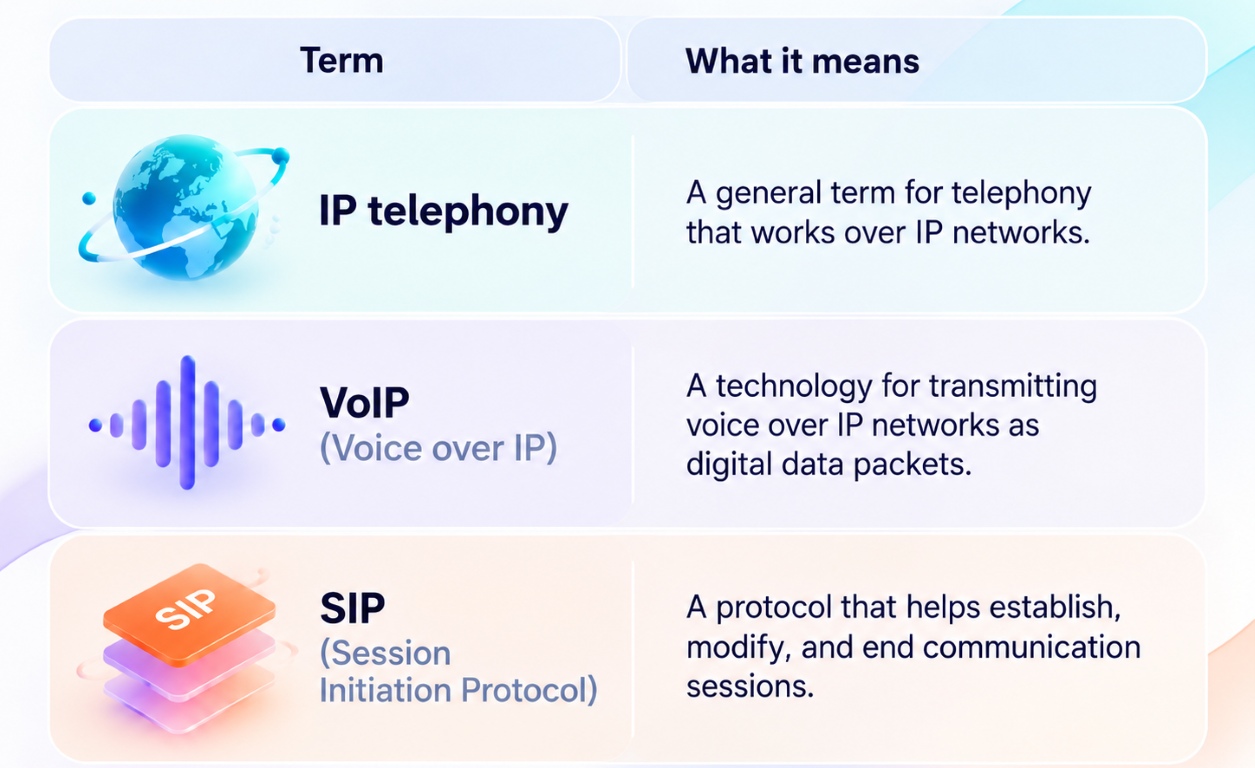
Put simply, IP telephony is the overall communication system, VoIP enables voice transmission, and SIP helps devices establish a connection. However, SIP is not the only protocol that can be used to set up VoIP calls.
How Does SIP Telephony Work?
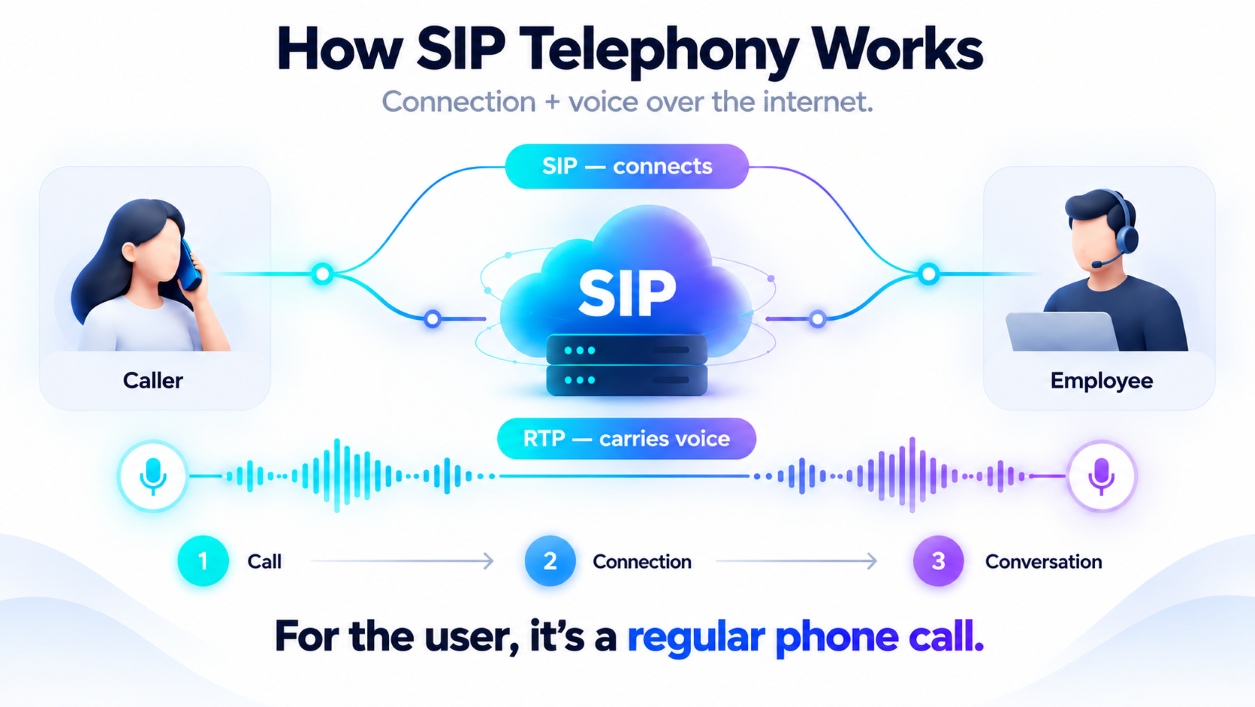
When a customer calls a company’s phone number, SIP telephony helps establish a connection with the appropriate employee. The process takes just a few seconds and involves several steps:
For users, the entire process feels like a regular phone call. The difference lies in how the connection is established and how voice is transmitted between the participants.
What Benefits Does SIP Telephony Offer Businesses?
SIP telephony enables companies to organize telephone communications without relying on traditional phone lines or fixed workstations. This simplifies employee setup, supports remote teams, and makes it easier to expand the telephone network.
These benefits do not require a cloud PBX. However, if a company needs to distribute calls among managers, track statistics, and monitor customer interactions, it can extend its telephony capabilities with a Virtual PBX.
These capabilities allow a company to tailor its telephone communications to its needs, from a few workstations to a distributed team across several cities. The telephone infrastructure can also be expanded gradually without substantially rebuilding the existing system.
SIP Telephony and Virtual PBX: What Capabilities Does a Company Gain?
SIP establishes telephone connections, while a Virtual PBX helps manage calls within the company. This is particularly useful for sales departments, support teams, and businesses with multiple offices, where it is important not only to answer a call but also to route it to the right employee and retain information about the inquiry.
For example, Stream Telecom’s Virtual PBX can provide:
- Multi-channel calling. Several customers can call the same business number simultaneously, provided enough call channels are available.
- Automatic call distribution. The system routes calls to the appropriate department, an available manager, or a queue according to predefined rules.
- Interactive voice response (IVR). Customers can select the relevant department or type of inquiry using their phone keypad.
- Call recording. Supervisors can listen to calls, assess service quality, and verify agreements made with customers.
- Call statistics. Data on the number of inquiries, missed calls, call duration, and employee workloads helps analyze team performance.
Another advantage of a cloud PBX is that the telephone system is less dependent on the office’s power supply. During a power outage, the Virtual PBX itself continues to operate on the provider’s servers. If call reception through smartphones, backup internet, or call forwarding has been configured in advance, the company can stay connected with customers even when office equipment is powered off.
It is also possible to set up telephony integration with CRM. Call information will then be automatically recorded in the system, managers will be able to view interaction history, and supervisors will be able to monitor customer communications. Specific capabilities depend on the CRM and the integration settings.
In other words, SIP telephony provides communication over IP networks, while a Virtual PBX adds tools for organizing and monitoring call handling.
What Do You Need to Set Up SIP Telephony?
Getting started with SIP telephony is relatively straightforward. In most cases, there is no need to buy specialized equipment or modify the existing office infrastructure. You will need:
- a stable internet connection;
- a computer with a headset, a smartphone with a SIP app, or an IP phone;
- a SIP connection from a provider and a telephone number for calling customers.
Once these are in place, you only need to configure the devices and test incoming and outgoing calls. If necessary, the telephony service can be connected to a Virtual PBX or CRM to enable additional customer communication features.
If a company wants to stay connected during power outages, it should arrange backup internet access and power for its equipment in advance. Another option is a smartphone with mobile data, provided the operator’s network remains available.
Contact Stream Telecom to set up SIP telephony tailored to your business needs. We will help you select phone numbers, configure IP telephony, and integrate it with a Virtual PBX and CRM if needed. You will not have to navigate the technical settings on your own — we will help you organize communications for your team.
Frequently Asked Questions About SIP Telephony
Recommended articles
How Corporate Telephony Is Changing and Why Businesses Are Switching to SIP Numbers
Read article
What Is SIP Telephony and How It Works
Read article