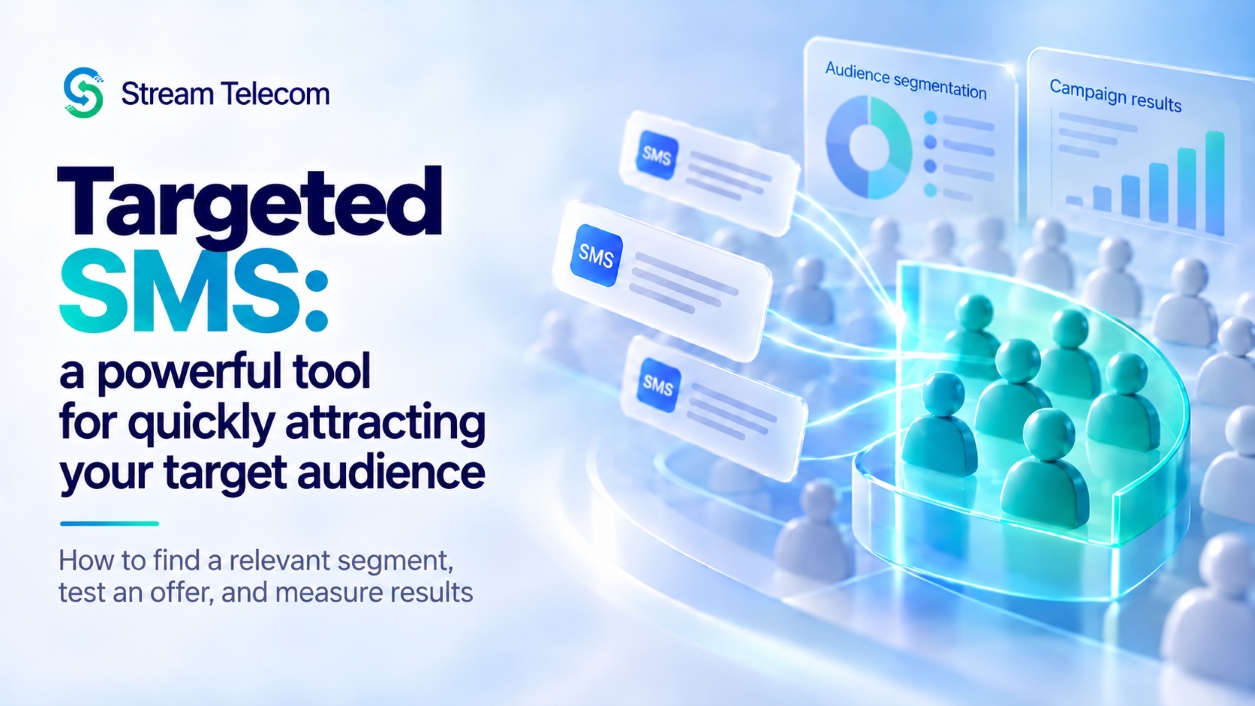
Targeted SMS: A Powerful Tool for Rapidly Attracting Your Target Audience
A business opens a new location, launches a service, or prepares a seasonal offer. Promoting it to everyone makes little sense: a restaurant needs to reach people who spend time nearby, a car dealership — those interested in cars, and a travel company — those who travel regularly. But how can you find the right audience without your own contact database?
For this purpose, businesses use targeted SMS campaigns. The mobile operator creates an audience segment based on available criteria — location, age, interests, or behavioral indicators — and sends a promotional message. The business does not receive subscribers’ phone numbers or other personal data, but it can present a specific offer to people who are potentially interested.
As advertising on Meta and Google becomes more expensive, SMS adds a direct communication channel that does not depend on social media feeds. For target audience acquisition, it offers a way to test an offer with a relevant segment.
Why Businesses Use Targeted SMS to Attract Their Target Audience
The main advantage of SMS is the short path from an offer to an action. People receive a specific offer and know what to do next: follow a link, use a promo code, or place an order.
For businesses, this creates several opportunities:
A standard report does not show Open Rate: it records messages sent and delivered. Campaign response is therefore assessed through clicks on UTM-tagged links, redeemed promo codes, inquiries, or purchases. These data can be used to calculate conversion rates, cost per lead, and CAC.
How Big Data Helps Identify the Right Customers
Big Data from mobile operators makes it possible to build an audience even when a company does not have its own contact database. A marketer describes the desired customer profile, and the operator checks the available segment against the specified criteria.
The selection may include:
- age, gender, and other demographic characteristics;
- city, district, or presence within a specified area;
- interests, lifestyle, travel habits, and visits to certain locations;
- device type, digital habits, or similarity to the profile of existing customers.
Geotargeting helps businesses check the segment size before launch, while location-based messaging narrows the reach to people who can take advantage of a local offer.
Three Ways to Use Targeted SMS
Targeted SMS can be adapted to different business objectives. It is most often used in the following scenarios:
Here are the results of several targeted SMS campaigns carried out for our clients: a clothing store in Dnipro recorded 94 purchases after a campaign reaching 2,300 recipients, a sushi delivery service in Kyiv saw 270 promo codes redeemed after a campaign reaching 1,800 recipients, and 85 people attended a music evening at a café in Kharkiv after 950 SMS messages were sent.
Offer Checklist for a Cold Audience
To keep SMS lead generation from becoming a campaign with no response, check your message:
The formula for an effective message is benefit + condition + one action. For example: “−20% on your first order until Sunday. Get your promo code: [link]”. This approach to SMS marketing for customer acquisition does not try to tell people everything about the company; it guides them toward the next step.
How to Turn a Test into a Manageable Acquisition Channel
Targeted SMS campaigns for businesses should start with one clear hypothesis: choose a segment, formulate an offer, and define the desired action. After launch, compare the actual response, CPL, and CAC with your planned targets.
If the hypothesis proves successful, you can expand the segment. If the results fall short of expectations, change one element at a time — the audience, offer, message copy, or sending time. This makes it easier to understand what affected the response.
With this approach, targeted SMS campaigns for businesses can become a manageable customer acquisition channel. Let the Stream Telecom team handle your campaign launch. We will help define audience selection criteria, check the available segment, prepare the message, agree on the budget, and set up the campaign. After sending, we will provide a delivery report so you can assess the actual response and decide whether to scale the campaign.