How Call Tracking Works: Tracking Phone Calls and Analyzing Advertising Performance
A customer may arrive at a website through Google Ads, browse several pages, and make a call without submitting an online inquiry. If phone inquiries are not tracked, that call will not appear in advertising conversion reports. As a result, a business may underestimate the performance of effective campaigns and allocate its marketing budget incorrectly.
Call tracking helps establish a link between advertising and phone inquiries. Let’s look at how the system identifies the source of a call, what data a business receives, and how to use that information to evaluate the effectiveness of its marketing strategy.
What Is Call Tracking and Why Is It Needed?
Call tracking (Call Tracking) is a technology for tracking phone inquiries that identifies which advertising sources generate calls to a company.
This is done using dedicated phone numbers or automatically replacing numbers on a website. It allows businesses to include calls in advertising analysis and evaluate which channels attract potential customers.
For example, a company runs ads simultaneously through Google Ads, Instagram, and billboards. Call tracking helps determine how many calls each source generated and compare the results of advertising campaigns.
Standard telephony statistics show the number of calls, their duration, and their status. Call tracking adds information about the advertising sources behind those inquiries. This gives marketers a more complete picture of advertising performance by accounting for both website inquiries and phone calls.
How Call Tracking Works: From an Ad to a Phone Call
To identify the source of a call, a call tracking system uses dedicated phone numbers. These numbers can be permanently assigned to advertising sources or automatically changed on the website when a new visitor arrives.
Let’s see how this works using dynamic call tracking as an example:
For the customer, everything works like a regular phone call: they dial the number shown on the website and speak with a manager. Meanwhile, the company receives information about the advertising source of the inquiry and, where the relevant data is available, the specific campaign that brought the visitor to the site.
The defining feature of call tracking is the link between an advertising visit and a phone inquiry. Instead of simply seeing the total number of calls, a business can identify which channels and campaigns generate them.
Static vs. Dynamic Call Tracking: What Is the Difference?
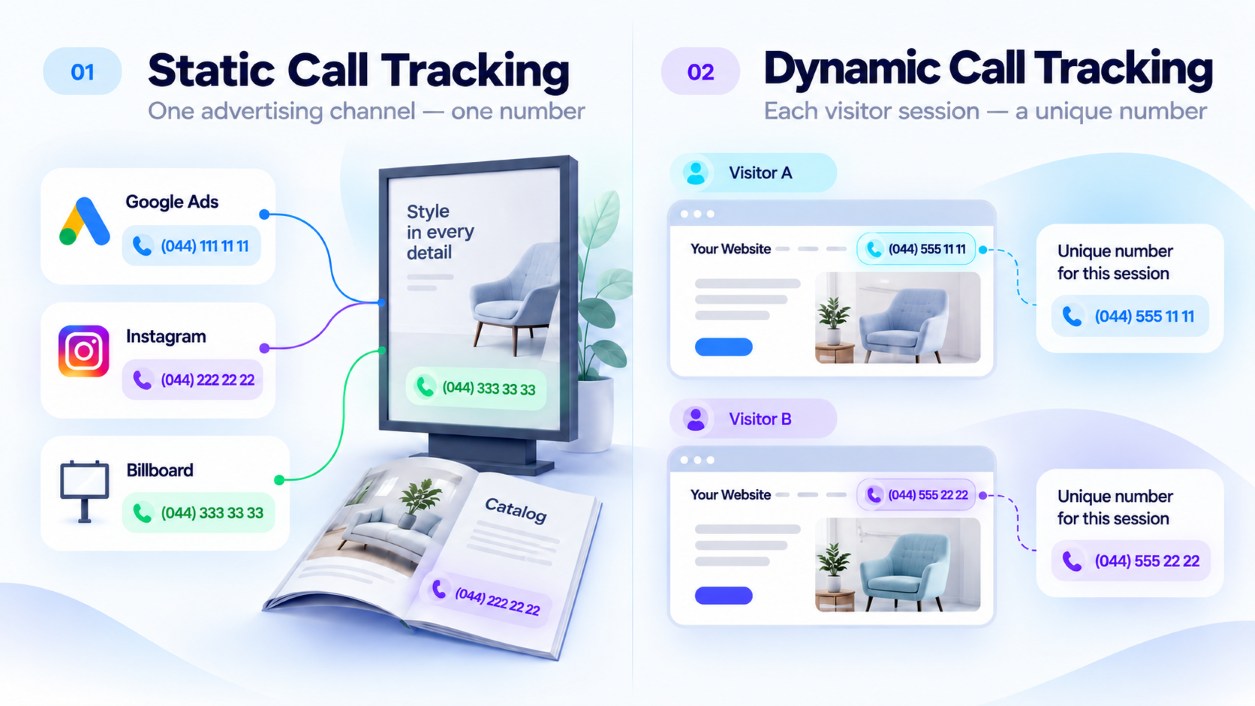
There are two main types of call tracking: static and dynamic. The key difference lies in how phone numbers are used and how detailed the data about call sources is.
Static call tracking involves assigning a separate phone number to an advertising source. For example, one number is displayed on a billboard and another in a printed catalog. The system identifies the source of an inquiry based on the number that received the call. This approach is suitable for offline advertising and individual online ads.
Dynamic call tracking automatically replaces phone numbers on a website using a dedicated pool of numbers. Each number is temporarily assigned to a specific visitor’s session. This makes it possible to identify not only the advertising channel but also the campaign and other visit parameters, provided the relevant data is available.
If a company uses multiple advertising channels, both approaches can be combined. Combined call tracking makes it possible to track calls from offline advertising using fixed numbers and website inquiries using dynamic number insertion.
What Data Can You Obtain with Call Tracking?
The main purpose of call tracking is to identify which advertisement generated a call. Combined with telephony data, this provides more detailed information about customer inquiries.
Depending on the system settings, reports may display:
These data show which advertising sources generate phone inquiries, but they do not always indicate the quality of those inquiries. For example, some calls may concern orders that have already been placed or follow-up consultations.
If call tracking and telephony are integrated with a CRM, data about advertising sources can be matched with lead statuses, deals, and sales. This allows a company to see not only the number of calls generated by advertising but also the outcomes of subsequent interactions with customers.
How Call Tracking Helps Evaluate Advertising Performance
A high volume of calls does not necessarily mean an advertising campaign is effective. It is important to understand how many inquiries come from potential buyers and how much it costs to acquire them.
Consider a hypothetical example.

Campaign A generated more calls at a lower cost. However, Campaign B generated 60% more qualified inquiries, with a cost per qualified inquiry that was 37.5% lower.
This comparison helps marketers identify which campaigns attract more potential customers and where advertising budgets should be allocated. If the CRM also contains information about closed deals and their value, campaign performance can be evaluated based on the number of sales and revenue generated, rather than phone inquiries alone.
What Affects Call Tracking Accuracy?
Call tracking accuracy depends on proper system configuration and the availability of advertising visit data. To ensure calls are correctly attributed to advertising sources, several factors should be considered:
Advertising URL tagging. UTM parameters help identify campaigns and other details about visits. If tagging is missing or contains errors, some information may be unavailable.
Number of tracking numbers. Dynamic call tracking requires a sufficiently large pool of numbers based on website traffic. Otherwise, the system may not always be able to attribute a call unambiguously to a specific session.
Correct number insertion. The call tracking script must correctly replace phone numbers across the website, including its mobile version.
Visitor behavior. Repeat visits, calls made some time after visiting the website, and browser restrictions may affect data completeness.
Properly configured call tracking provides more reliable information about the sources of phone inquiries. After launch, it is therefore important to check number insertion, make test calls, and verify that advertising sources are displayed correctly in the reports.
How to Start Using Call Tracking in Your Business
Before implementing call tracking, a company should determine which advertising channels need to be tracked and how much analytical detail is required. These requirements determine the choice of static, dynamic, or combined call tracking, as well as the number of phone numbers needed.
Call Tracking by Stream Telecom enables businesses to track phone inquiries from online and offline advertising, identify their sources, and send call data to a CRM and Google Analytics 4 (GA4). This makes it possible to count phone inquiries as conversions, analyze advertising campaign performance, and use the collected data to optimize Google Ads campaigns when the appropriate integrations are configured.
Submit a request on our website, and our specialists will help you choose a solution for your business. Our experts will help determine the right type of call tracking, select phone numbers, configure call tracking, and verify that the system is working correctly.
Recommended articles
Call Tracking for Small Business: Which Ads Really Bring You Calls Slug: call-tracking-small-business
Read article
How to Set Up Call Tracking on a Website
Read article